Local Business Reputation Statistics: What the Data Shows
Quick Answer
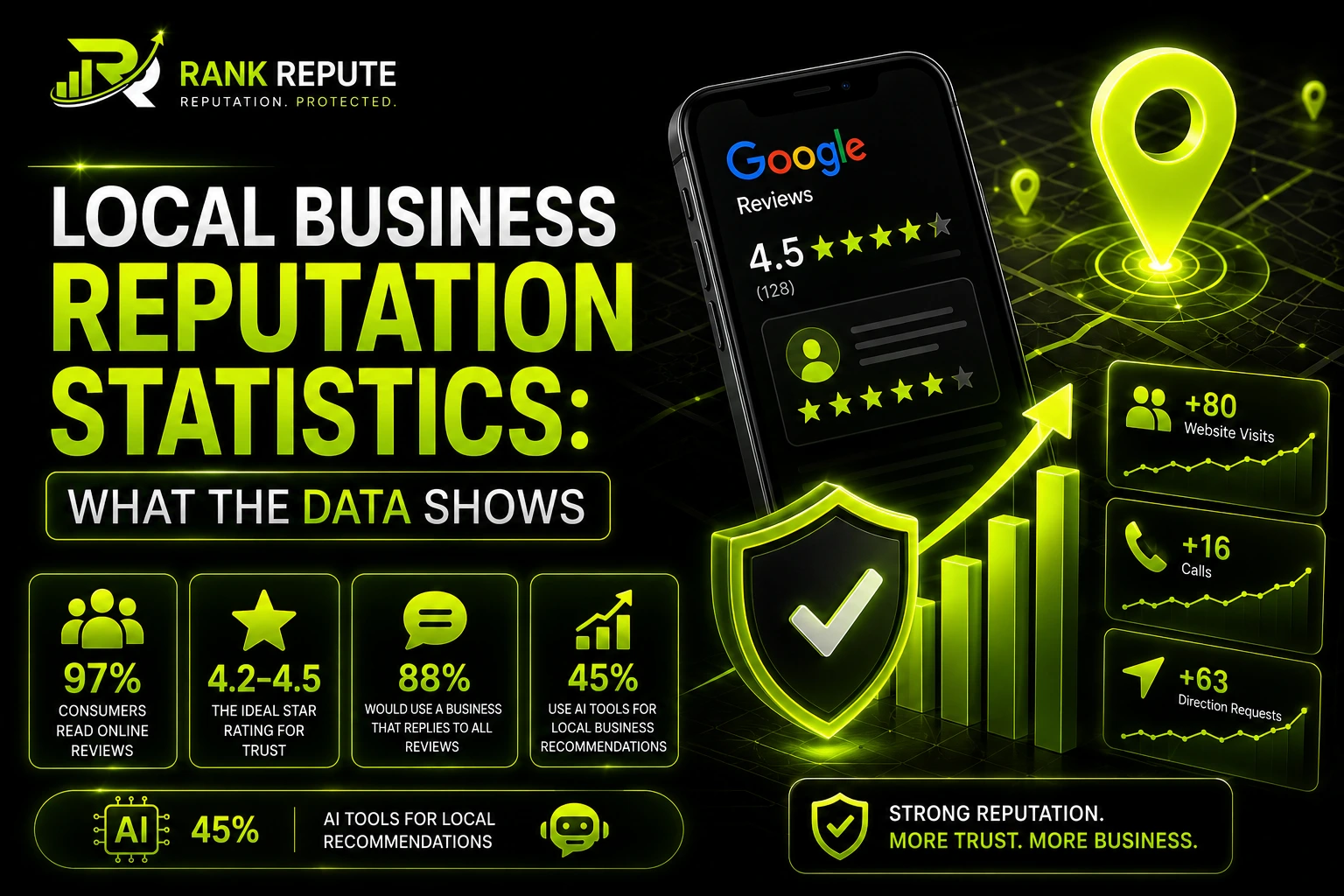
Nearly all consumers read reviews before choosing a local business, most trust a rating between 4.2 and 4.5 stars over a perfect 5.0, and the vast majority expect businesses to respond to reviews. A newer shift stands out, too: use of AI tools like ChatGPT for local recommendations has climbed to become the third most popular source. The numbers below are drawn from named studies, mainly BrightLocal’s Local Consumer Review Survey, with the source listed for each.
Key Statistics at a Glance
| Statistic | Figure | Source |
|---|---|---|
| Consumers who read online reviews | 97% | BrightLocal |
| Consumers who “always” read reviews when browsing | 41% | BrightLocal |
| Share of review-reading that happens on Google | 71% | BrightLocal |
| Ideal star rating for trust | 4.2 to 4.5 | Northwestern Spiegel |
| Would use a business that replies to all reviews | 88% | BrightLocal |
| Would use a business that never responds | 47% | BrightLocal |
| Use of AI tools for local recommendations | 45% | BrightLocal |
How Many Consumers Actually Read Reviews?
Almost everyone. 97% of consumers now read reviews online before making decisions about local businesses. Reviews are no longer a nice-to-have signal. They are the default step before a first visit or purchase.
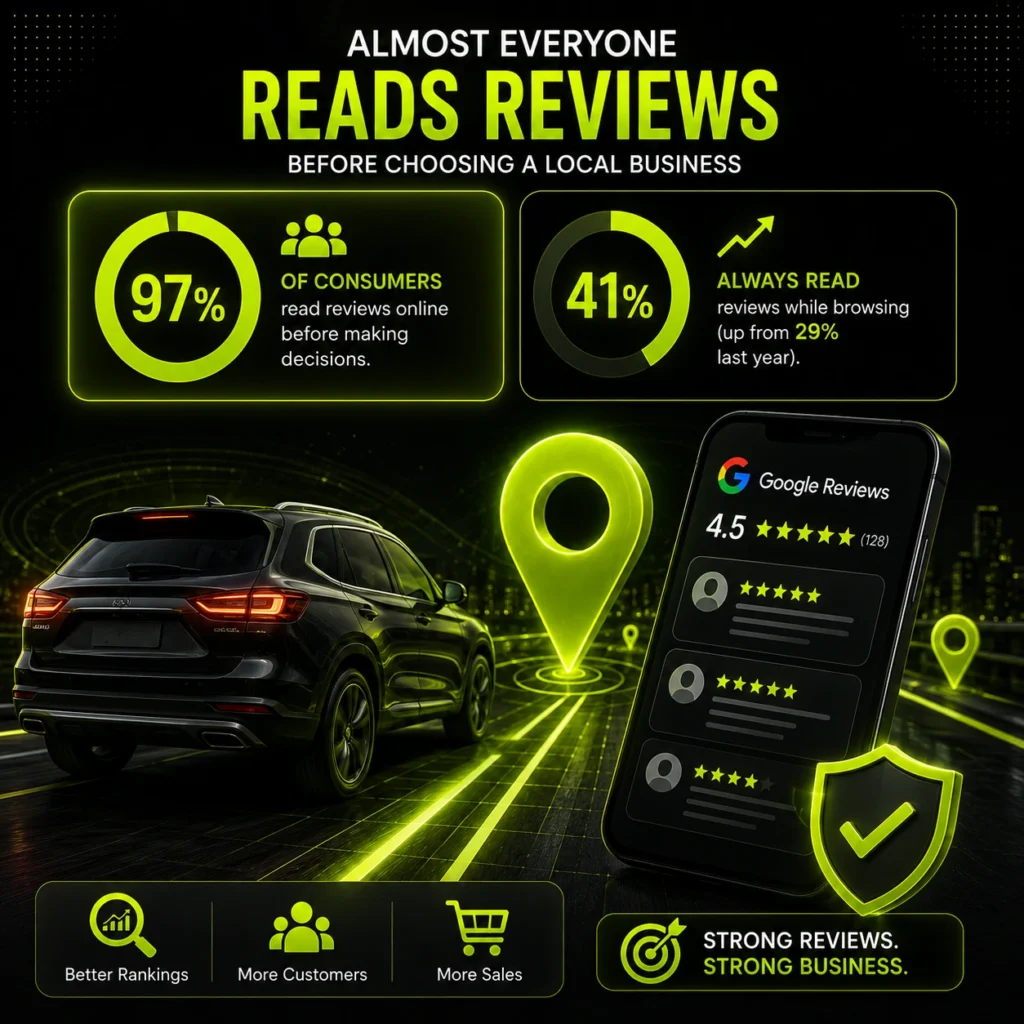
The intensity is rising too. The share of consumers who “always” read reviews while browsing has climbed to 41%, up sharply from 29% a year earlier. That reverses a slower-reading trend and suggests tighter budgets are making people check more carefully before they spend.
For a local business, the takeaway is blunt. If your reviews are thin, outdated, or poorly managed, you are losing customers at the exact moment they are deciding. This is why reviews affect local SEO and buying decisions at the same time.
What Is the Revenue Impact of Reviews?
This is the statistic business owners care about most, and it is backed by serious research. A landmark Harvard Business School study by Michael Luca found that a one-star increase on a review platform can lift revenue by 5% to 9%. Reviews are not a vanity metric. They move money.
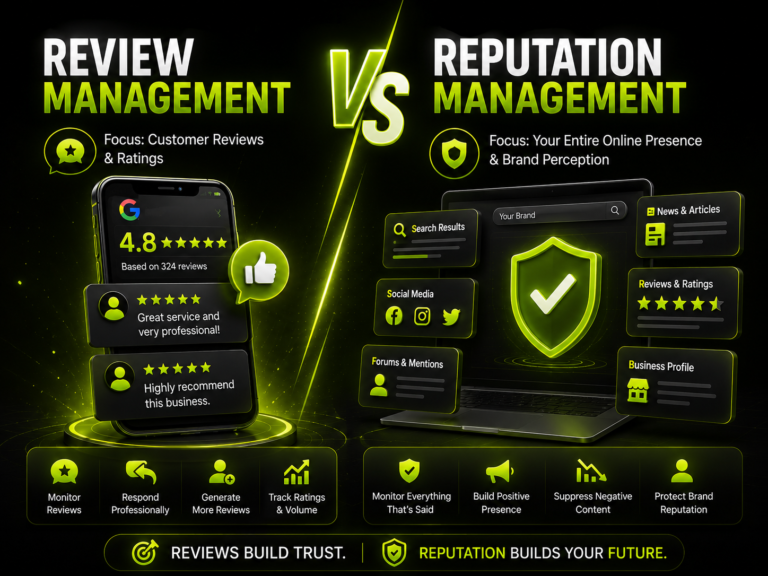
The compounding effect of individual reviews is just as striking. According to a Birdeye study, each additional Google review is associated with roughly 80 more website visits, 63 more direction requests, and 16 more calls. Every review you earn keeps working long after it is posted, which helps explain the importance of understanding review management vs reputation management as part of a wider business growth strategy.
| Metric | Impact | Source |
|---|---|---|
| One-star rating increase | 5% to 9% more revenue | Harvard Business School (Luca) |
| Each additional Google review | ~80 website visits | Birdeye |
| Each additional Google review | ~63 direction requests | Birdeye |
| Each additional Google review | ~16 calls | Birdeye |
That is the real case for a steady review generation programme. The returns are cumulative, and they show up directly in traffic, calls, and sales.
Do Reputation Expectations Differ by Industry?
Yes, and the differences are sharp. The rating threshold a customer demands depends heavily on what is at stake, so a score that is fine for one sector is a dealbreaker in another.
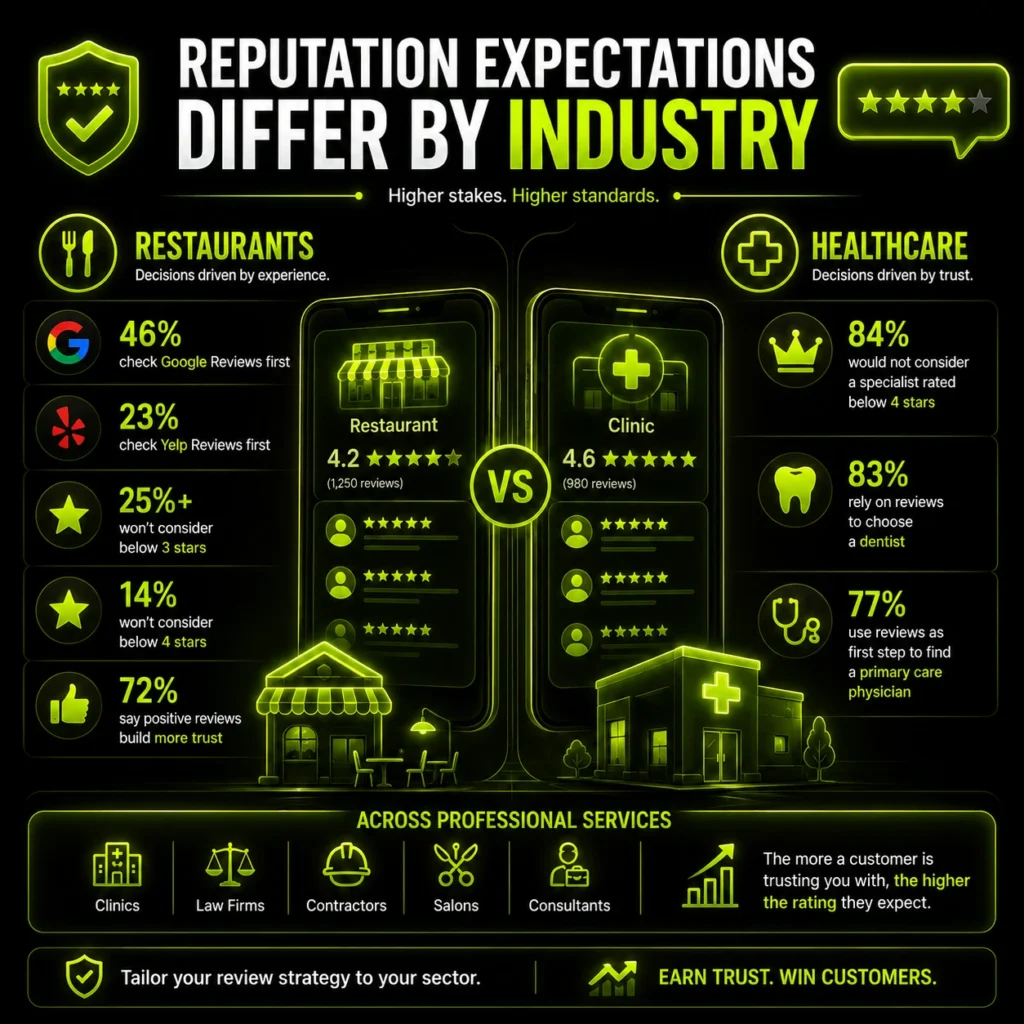
Restaurants live and die by fractions of a star.
- 46% of diners check Google Reviews first when judging a restaurant, and 23% check Yelp first.
- Over a quarter of diners will not consider a restaurant rated below three stars, and 14% rule out anything under four.
- 72% of consumers say positive reviews make them trust a local business more, according to BrightLocal.
Healthcare carries the highest trust bar, because the decision is personal and high-stakes.
- Around 84% of patients would not consider a specialist rated below four stars.
- About 83% of people rely on online reviews to choose a dentist, and 77% use reviews as their first step in finding a new primary care physician.
The pattern generalises across professional services, from clinics to law firms to contractors: the more a customer is trusting you with, the higher the rating and the more detailed the reviews they expect. A four-star profile that works for a takeaway may not clear the bar for a surgeon or an attorney. Tailoring your review strategy to your sector is part of proper review management.
Which Platforms Do Consumers Use for Reviews?
Google leads by a wide margin, but its dominance is loosening. Google’s share of review-reading has fallen from 83% to 71%, though it remains far ahead of every other platform. One reason is supply: only 35% of small and medium businesses have a Google Business Profile, which limits how many Google reviews consumers can even find.
Other platforms are shifting in notable ways:
| Platform trend | Change | Source |
|---|---|---|
| Apple Maps usage | 14% to 27% | BrightLocal |
| Local news sites as a review source | 48% to 29% | BrightLocal |
| AI tools for local recommendations | 6% to 45% | BrightLocal |
| Consumers who left a Google review in the past year | 45% | BrightLocal |
Trust also drives platform choice. Around 43% of US consumers have said the information they see on Facebook is untrustworthy, which helps explain why Google keeps its lead. The practical lesson is to build reviews across every site your customers actually use, not Google alone.
How Do Local and Mobile Searches Shape Reputation?
Reputation is increasingly checked on the move, often inside maps rather than a standard search box. Around one in five local searches happens directly within a maps tool like Google Maps, Apple Maps, or Bing Maps, making strong local SEO and listing accuracy more important than ever.
Two more findings underline how much the basics matter:
- 85% of consumers see contact information and opening hours as an important factor when researching a local business.
- Nearly three in five consumers search online for something multiple times a day.
For a local business, this means your Google Business Profile, map pin, hours, and phone number are reputation assets in their own right. A missing detail or a wrong opening time quietly costs you customers, before a single review is read.
What Star Rating Builds the Most Trust?
Not a perfect five. Research from Northwestern University’s Spiegel Research Center found that the ideal rating for trust sits between 4.2 and 4.5 stars, which outperforms a flawless 5.0. A handful of critical reviews reads as authentic. A spotless record reads as filtered or fake.
Star ratings still carry heavy weight, but not universally. The share of consumers who say a star rating does not influence their decision has doubled from 5% to 9%, a small but real signal that written detail is starting to matter more than the number alone. Detailed reviews that mention specific services feel more credible than a bare score.
What Do the Fake Review Statistics Say?
Fake reviews are now a mainstream consumer worry, and shoppers are getting better at spotting them. The trust problem cuts both ways: fake positives inflate bad businesses, and the fear of fakes makes people scrutinise every profile harder.
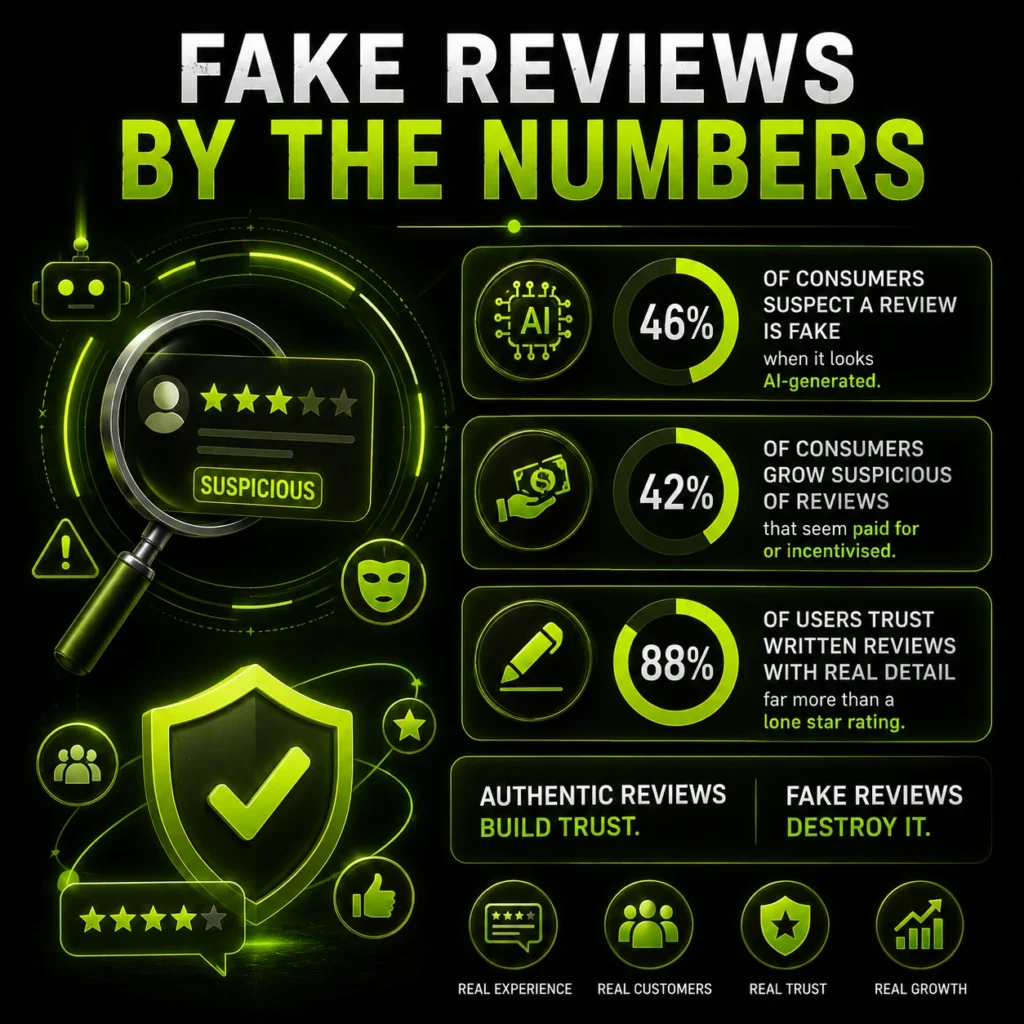
- 46% of consumers suspect a review is fake when it looks AI-generated.
- 42% grow suspicious of reviews that seem paid for or incentivised.
- Written reviews with real detail are trusted far more than a lone star rating, with roughly 88% of users favouring reviews that include text. The Washington Post
The practical signal is clear. Generic, overly glowing, or repetitive reviews now hurt credibility instead of helping it. Authentic feedback, including the occasional critical note, reads as more trustworthy than a wall of flawless five-stars. This is exactly why chasing fake positives backfires, and why knowing how to remove fake Google reviews the legitimate way matters.
Do Consumers Expect Businesses to Respond?
Yes, and the gap is dramatic. 88% of consumers would use a business that responds to all of its reviews, compared with just 47% who would use one that never responds. Responding is not customer service politeness. It is a conversion factor.
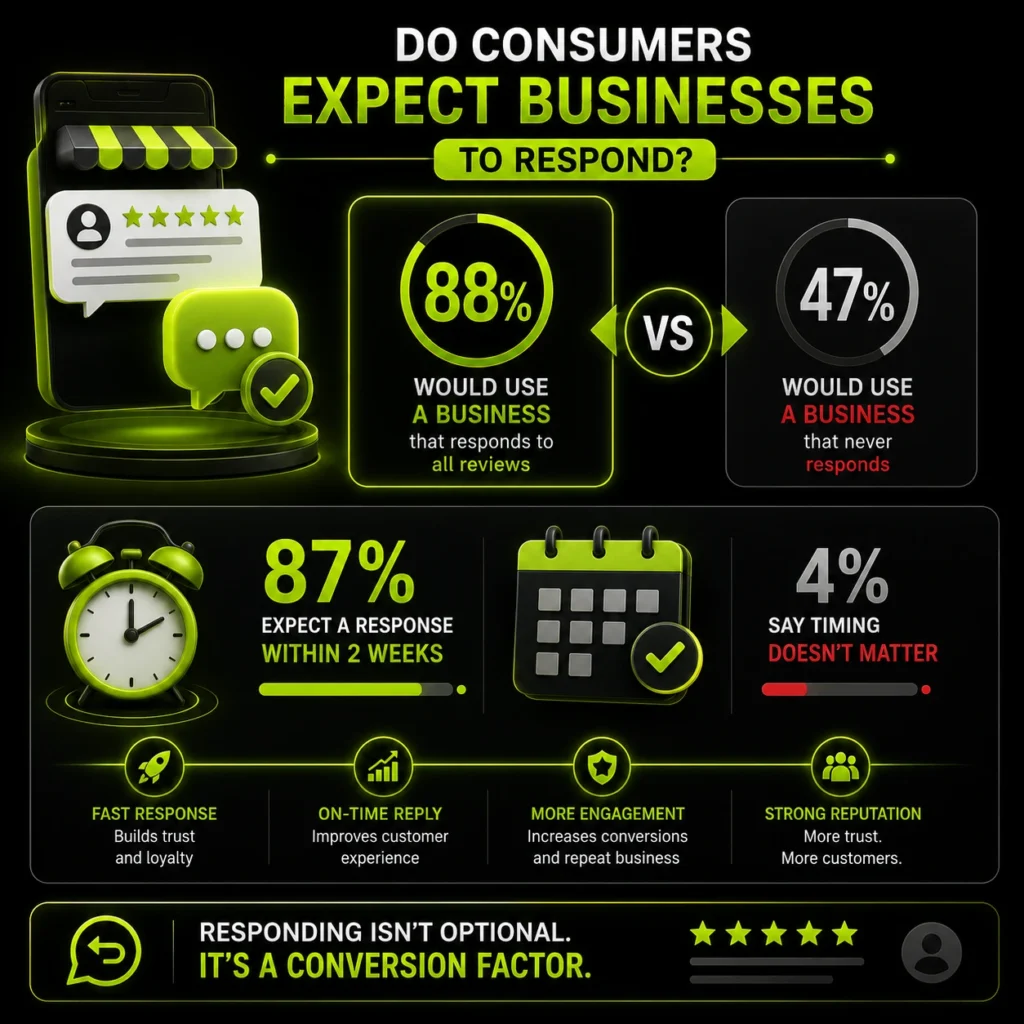
Timing matters as much as the reply itself. 87% of consumers expect a review response within two weeks, and only 4% feel the timing does not matter. A reply months late barely counts. If you want the method behind good replies, see our guide on responding to negative reviews.
Timing matters as much as the reply itself. 87% of consumers expect a review response within two weeks, and only 4% feel the timing does not matter. A reply months late barely counts. If maintaining that level of responsiveness is difficult in-house, a managed review response service can help ensure reviews are handled consistently and on time.
How Many Reviews Does a Business Need?
Fewer than you might think, and the bar is dropping. Consumers are growing more willing to choose businesses with as few as 0 to 49 reviews, with expectations for 50-plus reviews falling. Many now understand that review count is partly outside a business’s control, although understanding how reviews affect local SEO remains important for local businesses.
Most reviews still come from a small, active group:
- 20% of consumers have written more than 10 reviews.
- Just 7% have written more than 50, making a consumer as likely to write 50-plus reviews as to write only one.
Recency also shapes trust, since consumers focus most on reviews posted within the last month. A steady trickle of fresh reviews beats a big batch that then goes quiet. That is the job of a consistent review generation habit. For a fuller breakdown, see how many Google reviews a business needs.
AI and Reputation: The New Shift
This is the fastest-moving stat in the whole dataset. Use of ChatGPT and other generative AI tools for local recommendations has risen from 6% to 45% in a single year, making AI the third most popular source of business recommendations. People now ask AI chatbots where to eat, who to hire, and which clinic to trust.
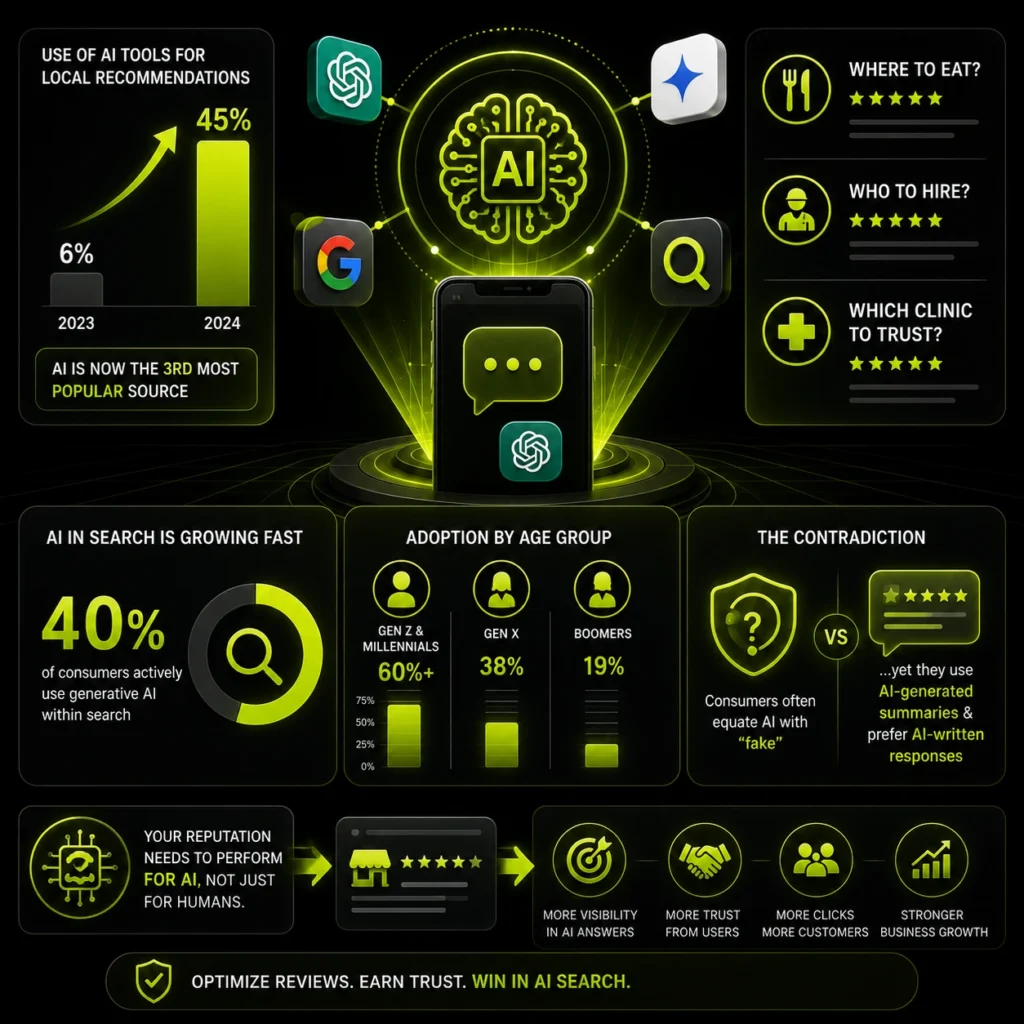
Search behaviour backs this up. 40% of consumers actively use generative AI within search, though adoption splits by age. Gen Z and Millennials sit above that average, while only 19% of Boomers say they actively use AI in search.
There is also a contradiction worth knowing. Consumers often equate AI with “fake,” yet they use AI-generated review summaries to guide their decisions, and, as noted above, many unknowingly prefer AI-written responses. For local businesses, the message is clear: your reputation now needs to read well to AI systems, not just to humans. That is a core part of modern online reputation management.
What These Numbers Mean for Your Business
The data points in one direction. Reviews decide first impressions, responses drive conversion, and AI is rapidly becoming a channel you cannot ignore. In practical terms:
- Collect reviews consistently across Google and the other sites your customers use.
- Respond to every review, ideally within two weeks.
- Aim for a natural rating in the low-to-mid four-star range, not an artificial 5.0.
- Keep reviews fresh, since recent feedback carries the most weight.
- Make sure your business is described accurately everywhere AI tools might read it.
Handling all of this by hand gets difficult fast, which is where structured review management earns its place.
Frequently Asked Questions
What percentage of consumers read online reviews?
97% of consumers read online reviews before deciding on a local business, according to BrightLocal. Review-reading is now near-universal, and the share who “always” check reviews has risen to 41%.
What is the ideal star rating for a local business?
Between 4.2 and 4.5 stars, based on Northwestern University’s Spiegel Research Center. This range builds more trust than a perfect 5.0, which many consumers read as too good to be genuine.
Do consumers expect businesses to respond to reviews?
Yes. 88% would use a business that replies to all its reviews, versus 47% for one that never responds, and most expect a reply within two weeks. Responding is one of the strongest trust signals you control.
How many reviews does a business need to be trusted?
Fewer than in past years. Consumers are increasingly comfortable choosing businesses with 0 to 49 reviews, and expectations for 50-plus reviews are falling. Consistency and recency now matter more than raw totals.
How are consumers using AI to find local businesses?
Rapidly and increasingly. Use of AI tools like ChatGPT for local recommendations has grown from 6% to 45%, becoming the third most popular recommendation source. Businesses now need accurate information wherever AI systems read it.
Which review platform do consumers trust the most?
Google, by a wide margin. Around 71% of review-reading happens on Google, far ahead of any other platform, though its share has slipped as consumers spread across Apple Maps, video sites, and AI tools. For most local businesses, a strong Google Business Profile is still the single highest-impact reputation asset.
How much can a better star rating increase revenue?
Meaningfully. A Harvard Business School study by Michael Luca found that a one-star increase on a review platform can raise revenue by 5% to 9%. Even small rating gains translate into real money, which is why consistent review generation pays for itself.
Are consumers worried about fake reviews?
Yes, and they are increasingly alert to them. About 46% of consumers suspect a review is fake when it looks AI-generated, and 42% distrust reviews that appear paid for or incentivised. Authentic, detailed reviews now build more trust than a wall of flawless five-star ratings.
What star rating do patients expect from healthcare providers?
Higher than most sectors. Roughly 84% of patients would not consider a specialist rated below four stars, and about 83% use online reviews to choose a dentist. Healthcare carries one of the highest trust bars, so ratings and detailed feedback matter more here than in lower-stakes industries.
How many review sites do consumers check before deciding?
More than one, almost always. Consumers now consult an average of around six review sites before choosing a business, and most cross-check at least two. Collecting reviews on a single platform is no longer enough; your reputation needs to hold up across Google, industry sites, and social platforms.
Methodology and Sources
Most figures here come from BrightLocal’s Local Consumer Review Survey, an annual study running since 2010. Its recent edition surveyed a representative panel of just over 1,000 US adult consumers through SurveyMonkey. Additional data is credited in line to Northwestern University’s Spiegel Research Center and Birdeye. Each statistic lists its source so you can verify it directly.
Conclusion
The reputation data tells a consistent story. Reviews are read by nearly everyone, a genuine four-star rating beats a suspiciously perfect one, fast responses win customers, and AI has arrived as a major discovery channel almost overnight. For local businesses, the winning move is not chasing a flawless score. It is building a steady, credible, well-managed review presence that reads well to both people and machines. If you want to turn these numbers into a plan, a reputation audit is the place to start.
Publications are welcome to cite this page. Please credit Rank Repute and link back to this article.