Negative Content Removal vs Suppression: Which Do You Need?
Quick Answer
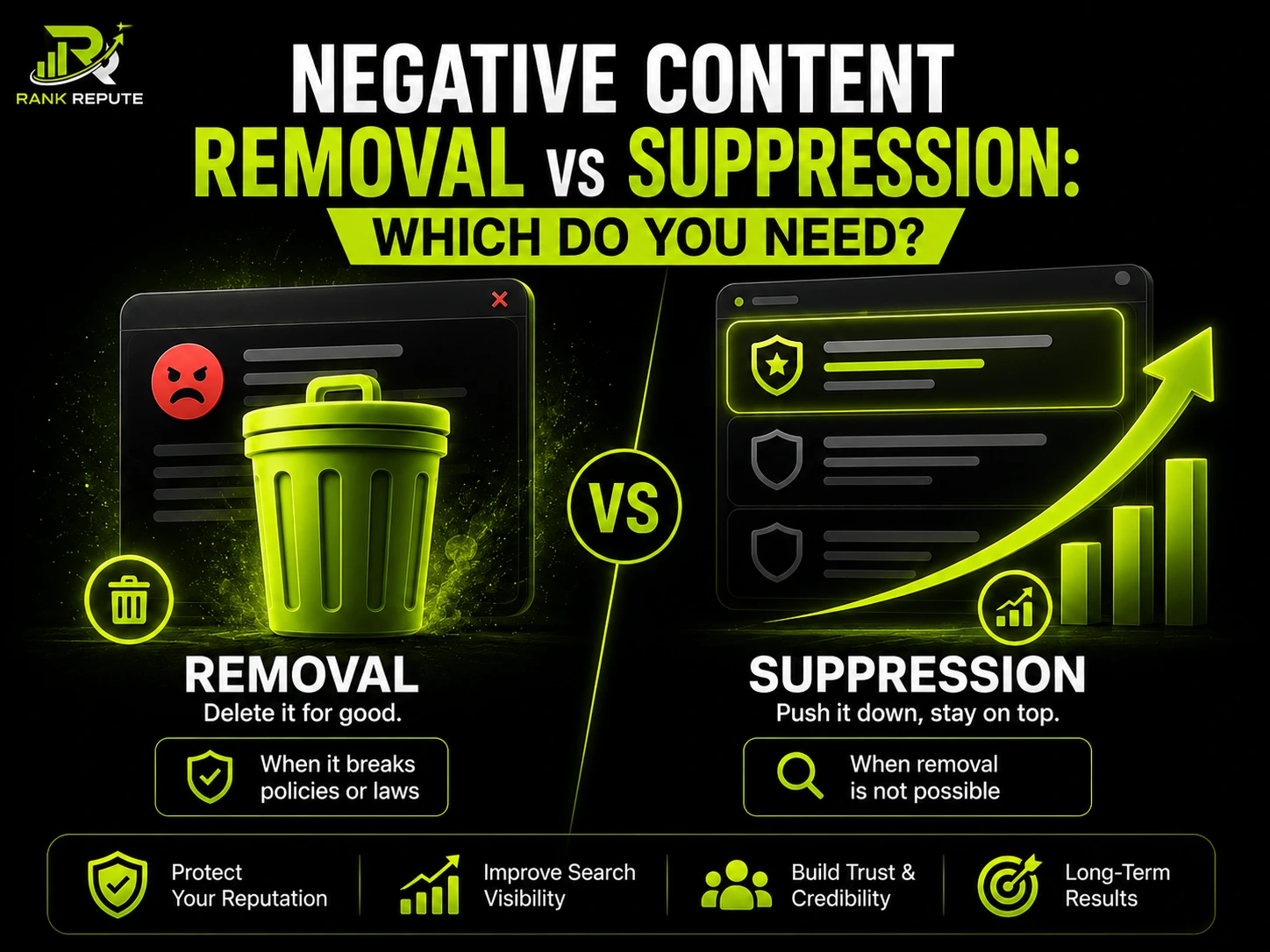
Negative content removal permanently deletes a damaging post, review, or article from the web. Suppression leaves the content online but pushes it below the first page of Google using SEO. Removal only works when the content breaks a platform policy or a law. Suppression is the fallback when removal is not possible, which covers most genuine negative content. Many businesses need both at once.
Introduction
You search your business name and a bad result sits near the top. Maybe it is a one-star review, an old news story, or a complaint on a forum. From here you have two very different paths, and choosing the wrong one wastes months. The whole debate around negative content removal vs suppression comes down to one question: can this content legally be taken down, or do you have to outrank it? This guide explains what each method does, when it works, what can actually be removed, and how the two fit together in a real reputation strategy.
What Negative Content Removal Actually Means?
Negative content removal is the permanent deletion of harmful content from its source. The post is gone, not hidden. It no longer appears in Google because it no longer exists.
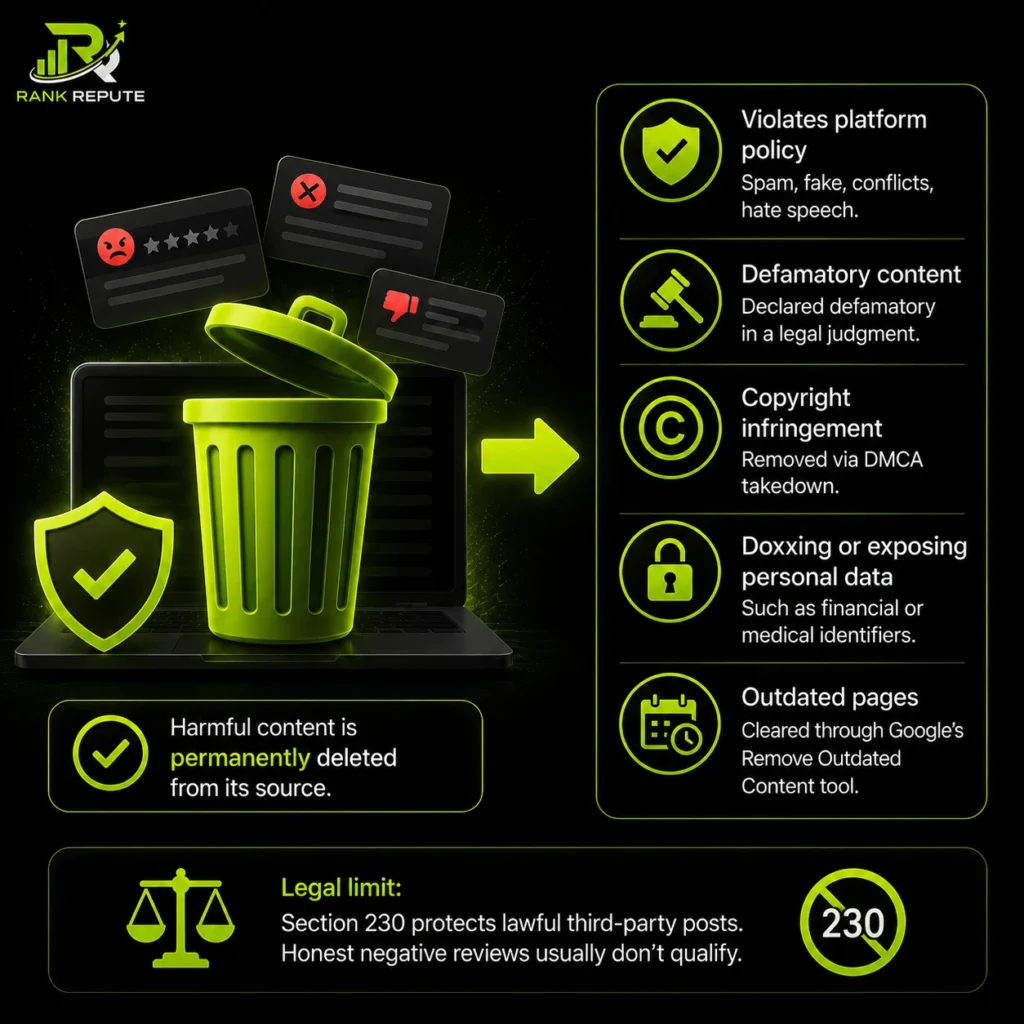
Removal is only possible in specific situations. A platform like Google, Yelp, or Trustpilot will remove content when it breaks the platform’s own rules. A search engine or website will remove content when a law forces it to. Common grounds include:
- Reviews that violate platform policy (spam, fake engagement, conflicts of interest, hate speech).
- Content that a court has declared defamatory in a legal judgment.
- Copyright infringement, addressed through a DMCA takedown notice.
- Doxxing or exposing personal data, such as financial or medical identifiers.
- Outdated pages that no longer exist were cleared through Google’s Remove Outdated Content tool.
The key limit is legal. In the United States, Section 230 of the Communications Decency Act means platforms cannot be forced to delete lawful third-party posts. So an honest negative review, even a harsh one, almost never qualifies for removal.
What Content Suppression Means
Suppression is an SEO strategy that pushes negative content off the first page of search results without deleting it. The content stays live, but few people ever see it.
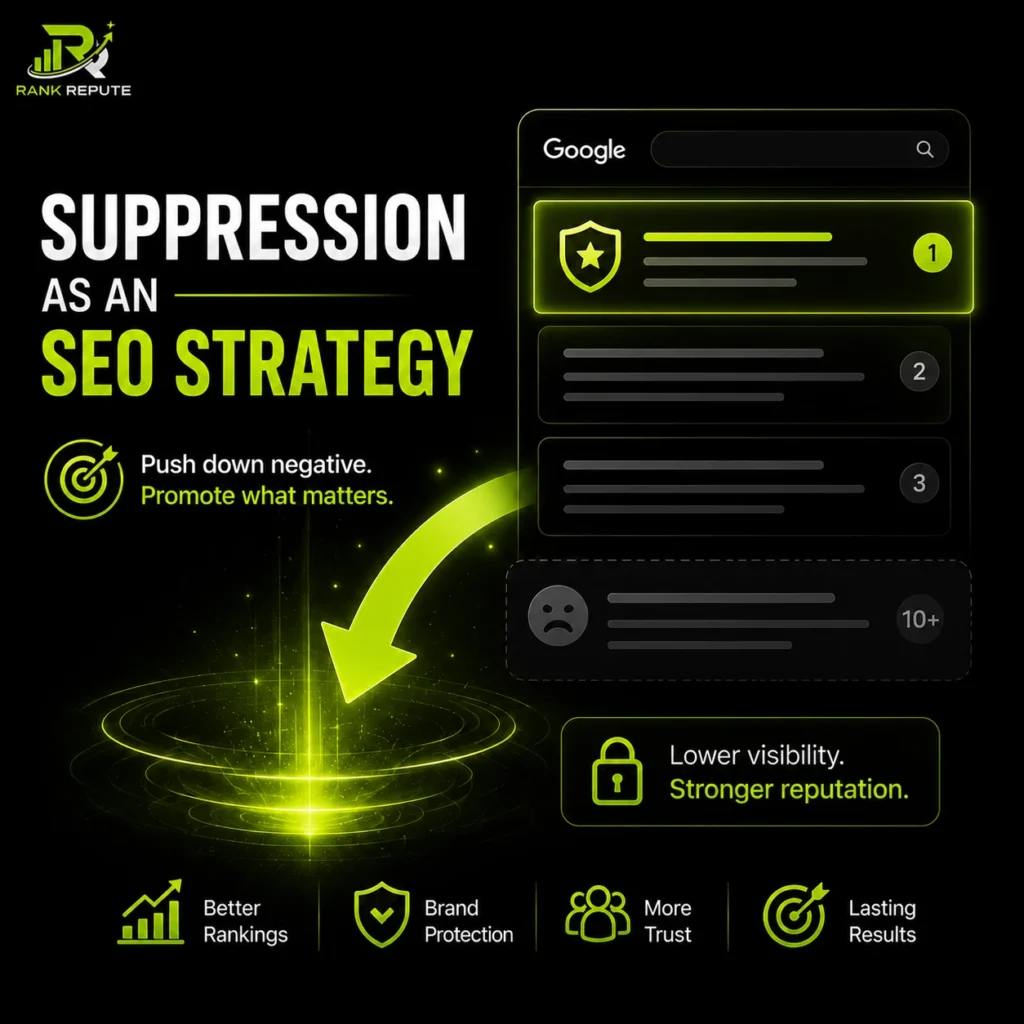
This works because of how search behaviour functions. The first page of Google captures the overwhelming majority of clicks, and very few users scroll to page two. If you can rank stronger, positive results above the negative ones, the negative results effectively disappear from public view. Suppression is also called “burying” or “de-ranking” content.
Suppression is the realistic option when removal is off the table. That includes genuine bad reviews, opinion articles, old press coverage, and posts on sites that refuse takedowns. Ripoff Report, for example, is known for keeping posts online even when the business disputes them. Removal is rarely an option, so suppression becomes the only practical fix.
Removal vs Suppression at a Glance
| Factor | Negative content removal | Content suppression |
|---|---|---|
| What happens to the content | Deleted permanently | Stays online, pushed down |
| Visibility result | Gone from the search entirely | Buried on page two or lower |
| When it works | Policy or legal violation only | When removal is not possible |
| Typical timeline | A few days to several weeks | Three to six months, sometimes longer |
| Main cost driver | Legal action or formal requests | Volume of content built and time |
| Best for | Fake reviews, defamation, illegal content | Genuine reviews, old news, opinions |
| Permanence | Permanent | Holds as long as positive assets stay strong |
Why Most Businesses Need Both Strategies?
Many businesses approach reputation management as if they must choose between content removal and content suppression. In reality, most reputation issues require both.
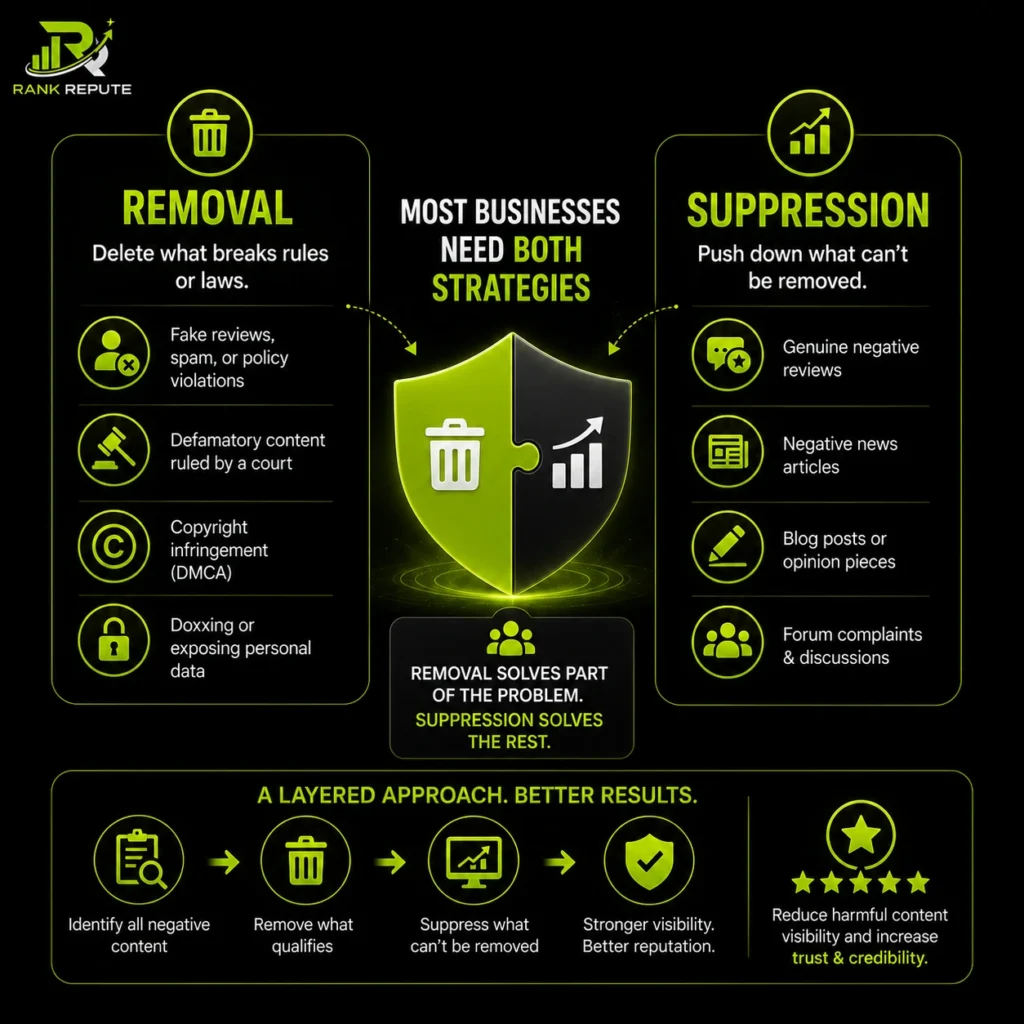
Search results rarely contain only one type of negative content. A business may be dealing with fake reviews, an old complaint forum post, a negative news article, and a misleading blog post at the same time. Some of these items may qualify for removal, while others remain fully protected by platform policies or free speech laws.
For example, a fake review that violates platform guidelines may be removed after investigation. However, a genuine customer complaint or a factual news article usually remains online. In that situation, removal solves part of the problem while suppression addresses the rest.
This is why most reputation management campaigns use a layered approach. Content that qualifies for removal is targeted first. Content that cannot be removed is pushed lower in search results through SEO, content development, digital PR, and authority-building efforts.
Rather than viewing removal and suppression as competing strategies, businesses should view them as complementary tools. The most effective reputation strategies often combine both methods to reduce visibility of harmful content while strengthening the visibility of positive and neutral assets.
When Removal Is the Right Move?
Choose removal when the content is fake, illegal, or breaks a clear rule. In these cases, deletion is faster and cleaner than years of suppression. Pursue removal for:
- Fake reviews from people who were never customers or coordinated review attacks.
- Reviews that contain spam, threats, harassment, or impersonation.
- Defamatory statements, where you can obtain a court order confirming the content is false.
- Copyright misuse, such as your photos or text being used without permission.
- Leaked private data like home addresses, ID numbers, or medical details.
For fake reviews specifically, the reporting and escalation steps are covered in our guide on how to remove fake Google reviews. For broader cases involving articles, blog posts, or third-party sites, professional negative content removal handles the legal and platform-side process.
When Suppression Is the Right Move?
Choose suppression when the content is lawful, and the platform will not delete it. This is the most common situation businesses face. Suppression fits when you are dealing with:
- Genuine one-star reviews or two-star reviews from real customers.
- Negative but factual news articles or blog posts.
- Opinion pieces that are protected speech, not defamation.
- Complaints on sites with a no-removal policy.
- Old content that ranks high simply because nothing newer outranks it.
The reason ties back to Section 230. A platform is allowed to keep lawful third-party content online, and courts will not order the removal of an honest opinion. Fighting to delete that content usually fails. Outranking it succeeds.
What Can Be Removed and What Cannot?
| Usually removable | Rarely or never removable |
|---|---|
| Fake reviews that break platform policy | Genuine negative reviews from real customers |
| Court-confirmed defamatory statements | Honest opinions and criticism |
| Copyright-infringing material (DMCA) | Factual news reporting |
| Doxxing and exposed personal data | Posts on no-removal sites like Ripoff Report |
| Outdated pages have already been deleted at the source | Forum threads that break no rules |
A useful note for non-US readers: the EU and UK have a “right to be forgotten” under GDPR Article 17, which can force search engines to de-list certain personal results. That right does not generally apply to businesses, and it does not exist in the same form in the United States. Most local businesses cannot rely on it.
Mistakes to Avoid With Both Strategies
Most reputation damage gets worse because of avoidable errors. These are the traps that cost businesses time, money, and trust.
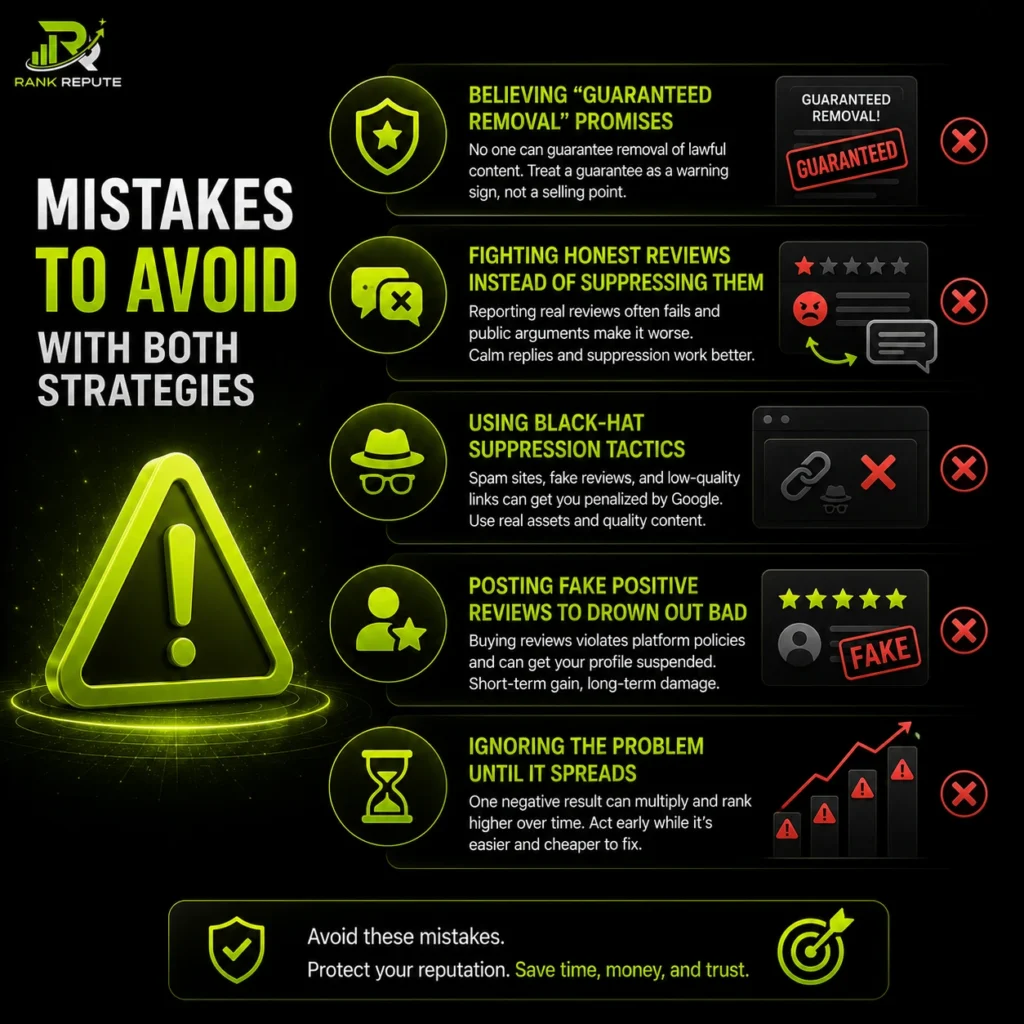
Believing “Guaranteed Removal” Promises
No one can guarantee the removal of lawful content. Any service that promises to delete a genuine negative review is either misleading you or planning to break platform rules. Google removes content on its own terms, not on payment. Treat a guarantee as a warning sign, not a selling point.
Fighting Honest Reviews Instead of Suppressing Them
Reporting a real customer’s honest review almost always fails, and a public argument makes it worse. Future customers read the exchange and judge the response, not just the rating. When content is lawful, suppression and a calm reply protect you far better than a removal request that will be rejected.
Using Black-Hat Suppression Tactics
Some providers try to bury negative results with spam sites, fake reviews, or low-quality link networks. These methods break Google’s guidelines and can trigger a manual penalty that buries your good content, too. Safe suppression uses real assets: your own site, verified profiles, genuine press, and quality content.
Posting Fake Positive Reviews to Drown Out the Bad
Buying or faking five-star reviews is a policy violation on every major platform. Google can remove the fake reviews, suspend the profile, and attach a warning label to your listing. The short-term lift is never worth the long-term risk.
Ignoring the Problem Until It Spreads
A single negative result is easier to handle than ten. Left alone, one damaging page can attract links, get quoted, and climb higher. Acting early, while the content is still weak, is cheaper and faster than reacting after it ranks.
How Suppression Works, Step by Step?
Suppression follows a repeatable SEO process. The goal is to fill page one with assets you control or influence, so the negative result drops out of view.
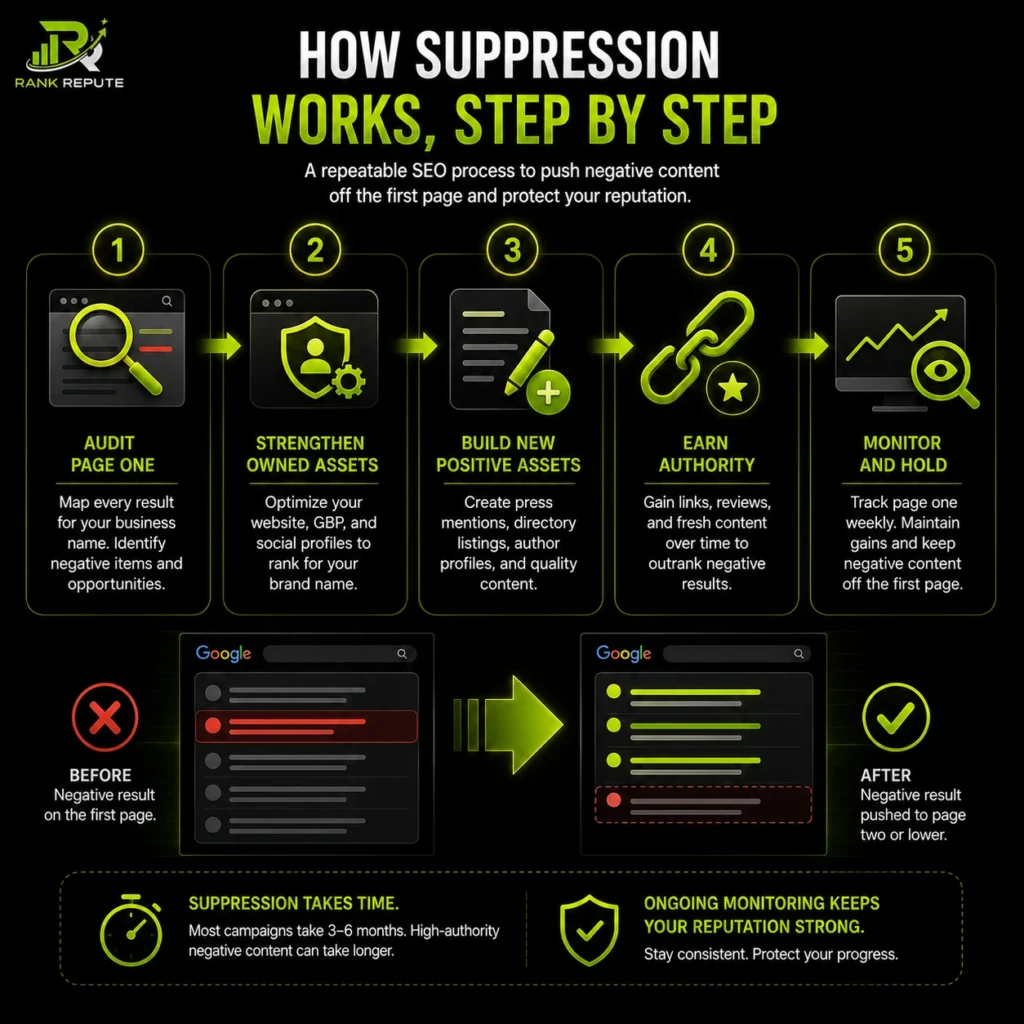
- Audit page one. Map every result that appears for your business name, including the negative items and the gaps you can claim.
- Strengthen owned assets. Optimise your website, Google Business Profile, and key social profiles so they rank for your name.
- Build new positive assets. Publish press mentions, directory listings, author profiles, and high-quality articles that target your brand terms.
- Earn authority. Add links, reviews, and fresh content over time so these assets outrank the negative page.
- Monitor and hold. Track page one weekly until the negative result moves to page two or lower, then maintain the gains.
This is slower than removal. A typical campaign takes three to six months, and a negative result on a high-authority site like a major newspaper can take longer. Ongoing reputation monitoring keeps the result from creeping back up.
The Biggest Myth About Online Reputation Management
Online reputation management is often misunderstood. Many people assume it means removing anything negative from Google. In reality, some content can be removed, while other content must be suppressed because it does not qualify for removal. Understanding this difference is essential when deciding how to protect and improve your online reputation.
Myth: Reputation Management Means Removing Everything Negative
Many people assume online reputation management is simply the process of deleting anything negative that appears on Google. In reality, most reputation work involves evaluating whether content can be removed and determining the best way to reduce its visibility when removal is not possible. Genuine reviews, factual articles, and lawful opinions often remain online regardless of how damaging they may be to a business.
Google Does Not Control Most Online Content
A common misunderstanding is that Google owns or publishes the content appearing in search results. Google primarily indexes content created by other websites. This means Google cannot remove every complaint, article, review, or forum discussion simply because a business requests it. In many situations, the source website has more control over the content than Google itself.
Removal Is Only Possible In Specific Situations
Content removal usually depends on a policy violation, legal issue, copyright infringement, privacy concern, impersonation, or other valid grounds. If the content does not violate a platform’s rules or applicable laws, removal requests are often unsuccessful. This is why businesses should not assume every negative search result can be deleted.
Most Reputation Problems Involve Lawful Content
Many reputation challenges come from content that is accurate, legally published, and protected by platform policies. Examples include genuine customer complaints, negative news coverage, opinion pieces, Glassdoor reviews, Reddit discussions, and forum posts. While these results may be frustrating, they often do not qualify for removal.
Reputation Management Is Often About Visibility Control
When content cannot be removed, the focus shifts to visibility management. This is where content suppression becomes important. By strengthening websites, social profiles, business listings, media coverage, and other positive assets, businesses can influence what appears most prominently in branded search results.
The Best Reputation Strategies Use Realistic Expectations
Businesses often waste time and money chasing guaranteed removals that are not legally or technically possible. Effective reputation management begins with understanding which content can realistically be removed and which content requires suppression. Setting realistic expectations leads to better decisions and stronger long-term reputation protection.
What is the Removal and Suppression Cost?
Cost depends on which route the content allows. Removal is usually a one-off fee per item, while suppression is a monthly cost that runs for several months.
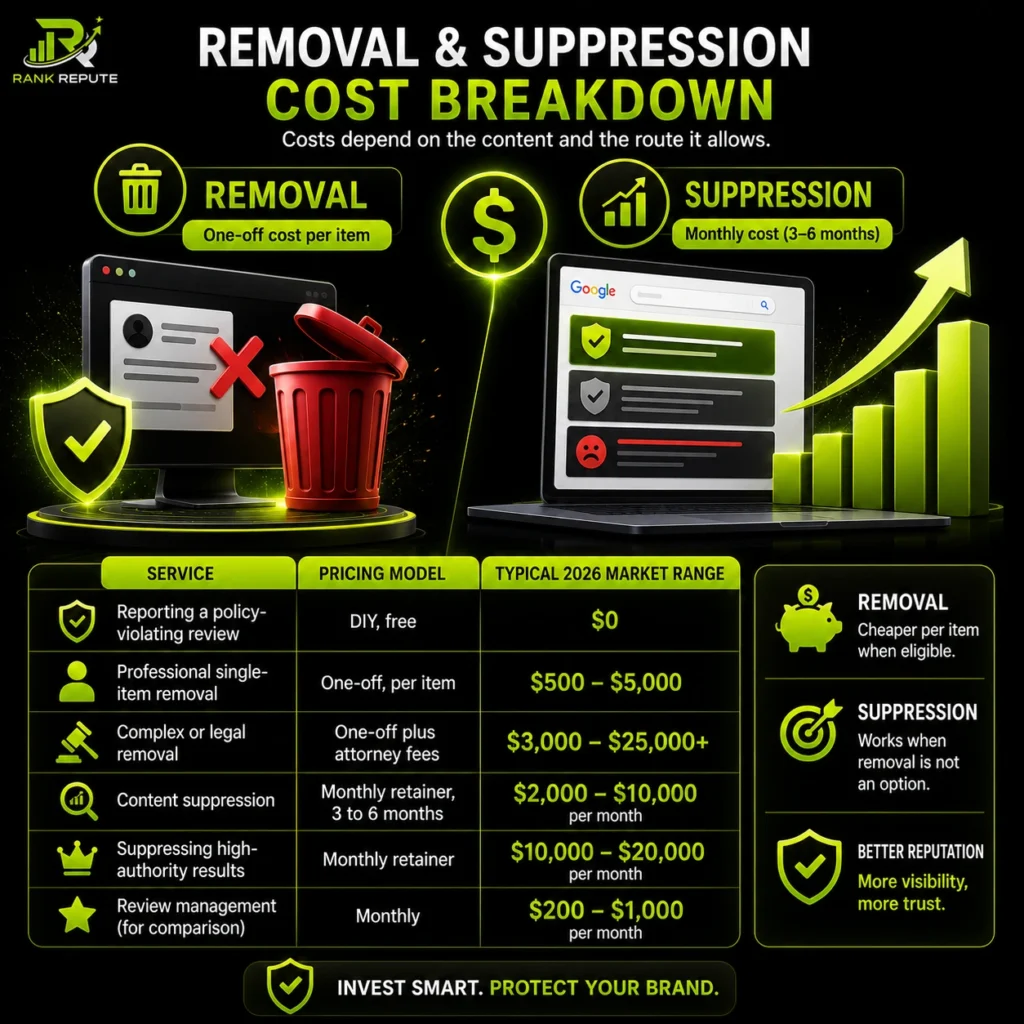
Removal has a wide range because some methods are free, and others need lawyers. Reporting a policy-violating review through Google or Yelp costs nothing, and filing a DMCA takedown yourself is also free. When you hire help, a single negative item removal typically costs between $500 and $5,000. Complex cases climb higher. A single content removal project can run from $3,000 to $25,000, mainly when a defamation claim needs a court order and attorney fees on top. SurveySparrowContent Removal
Suppression is priced as a monthly retainer, not a one-time fee. Across the industry, search result suppression usually costs $2,000 to $10,000 per month, and most campaigns take three to six months to show visible results. The price climbs with the strength of the negative page. Suppressing content from high-authority websites can cost $10,000 to $20,000 per month, because a national news article is far harder to outrank than a weak forum post. For context, the cheapest piece of the puzzle is everyday review work. Review management generally runs $200 to $1,000 per month. Reputn + 3
| Service | Pricing model | Typical 2026 market range |
|---|---|---|
| Reporting a policy-violating review | DIY, free | $0 |
| Professional single-item removal | One-off, per item | $500 to $5,000 |
| Complex or legal removal | One-off plus attorney fees | $3,000 to $25,000+ |
| Content suppression | Monthly retainer, 3 to 6 months | $2,000 to $10,000 per month |
| Suppressing high-authority results | Monthly retainer | $10,000 to $20,000 per month |
| Review management (for comparison) | Monthly | $200 to $1,000 per month |
The pattern is simple: removal is cheaper per item when you qualify, but suppression is the only spend that works when you do not. These are wider industry figures, not fixed quotes. Rank Repute runs on month-to-month plans with no long-term contracts, so you can see the actual tiers on our pricing page.
How Rank Repute Combines Both?
At Rank Repute, we do not treat removal and suppression as rivals. We treat them as a sequence. First we test whether each negative item qualifies for removal under the platform policy or law. Anything eligible, we move to delete. Whatever cannot be removed, we suppress with positive content and SEO.
This two-track approach matters because most search pages mix both types of content. A single result page might hold one fake review you can report and one honest article you cannot. Handling each correctly is faster and cheaper than forcing a single method onto everything. We then monitor the results so a buried page does not resurface and a new attack does not catch you off guard.
A Real-World Example of Both in Action
Seeing both methods together makes the difference clear. Consider a common situation for a local business.
Picture a dental practice that searches its name and finds two problems on page one. The first is a pair of one-star reviews from accounts that were never patients. The second is an old complaint on a forum that the site refuses to take down.
The two issues need two different fixes. The fake reviews break Google’s policy, so the practice reports them with evidence, and they are removed within a few weeks. The forum post is lawful, so removal is off the table. Instead, the practice strengthens its website, profiles, and a few press mentions. Over the following months, those assets climb, and the forum post slips to page two where almost no one looks. One problem was deleted. The other was buried. Both disappeared from public view.
FAQ
What is the difference between content removal and suppression?
Removal permanently deletes content from its source, so it no longer exists or appears in search. Suppression leaves the content online but pushes it below page one with SEO, so almost no one sees it. Removal needs a policy or legal reason to work. Suppression works in almost any case, but takes longer.
Can all negative content be removed from Google?
No. Google only removes content for specific legal reasons, such as a court order confirming defamation, copyright infringement, or exposed personal data. It will not remove honest reviews or factual reporting simply because they are negative. For that content, suppression is the realistic path.
Which strategy is better for my business?
It depends on the content, not your preference. If the item is fake, illegal, or breaks a platform rule, removal is better because it is permanent and fast. If the content is lawful, suppression is the only option that actually works. Most businesses use both, because a single search page often contains both types.
How long does reputation suppression take?
Most suppression campaigns show movement within three to six months. The exact timeline depends on how authoritative the negative page is and how much positive content already exists. A complaint on a weak forum drops quickly. A story on a national news site takes much longer to outrank.
Does Google remove negative reviews when a business asks?
Only when the review violates Google’s review policies, such as spam, fake content, conflicts of interest, or harassment. Google does not remove a review just because the owner disagrees with it. Genuine criticism stays online, which is why suppression and professional responses matter more than removal requests.
Conclusion
The choice between negative content removal vs suppression is not about which method is better. It is about which method the content allows. Removal wins when the post is fake, illegal, or against the rules, because deletion is permanent. Suppression wins for everything lawful, because you cannot delete an honest opinion, only outrank it. A strong reputation strategy uses both, then monitors the results so the problem does not return. If damaging content is sitting on page one of your brand search, the first step is a clear audit of what can be removed and what must be suppressed.