What Is Online Reputation Management? A Guide for Local Businesses
Quick Answer
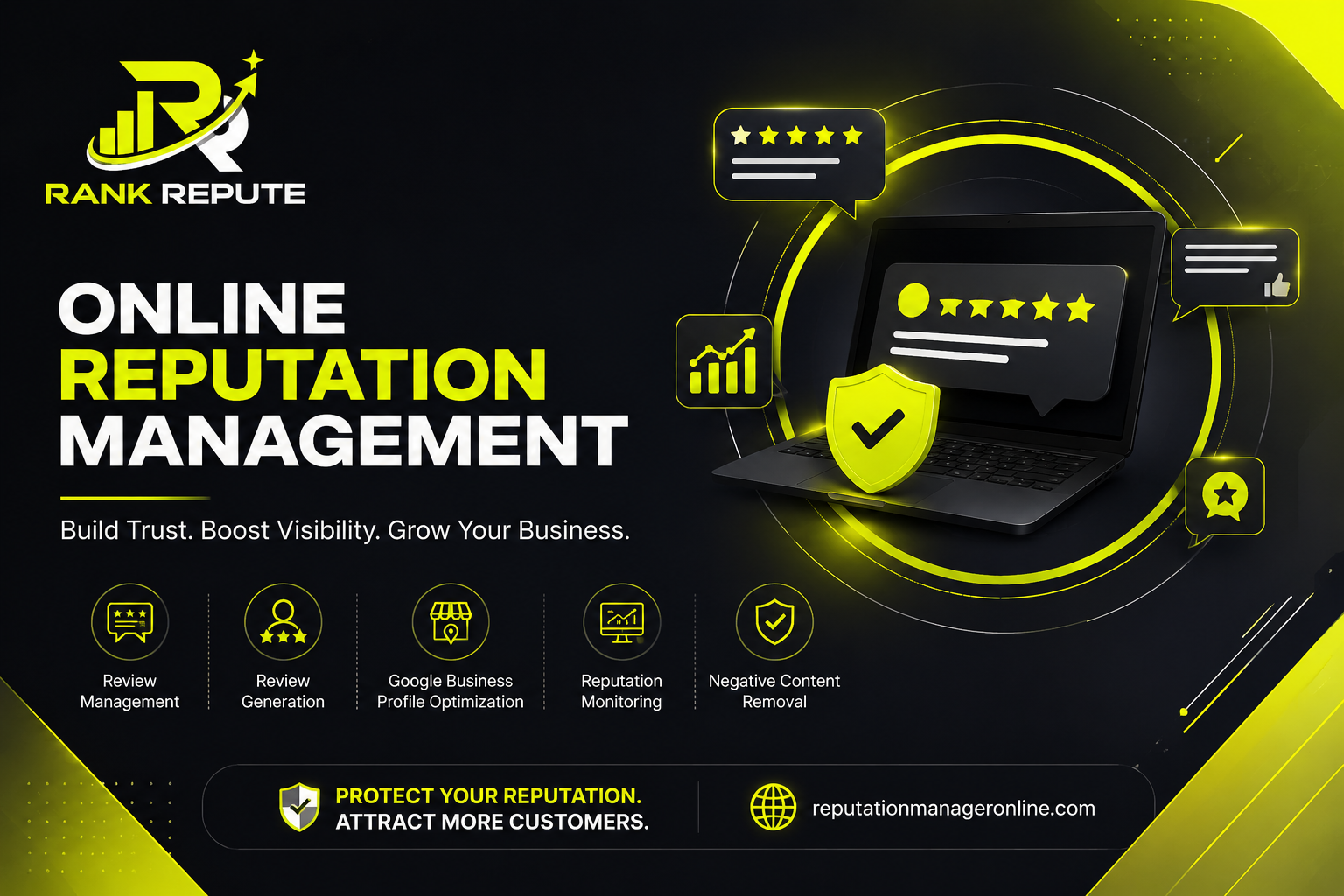
Online reputation management is the process of monitoring, improving, and protecting what people find when they search your business name online. It covers your Google reviews, star rating, Google Business Profile, search results, and presence across review platforms like Yelp, Facebook, and industry-specific directories. For local businesses, it is one of the most direct ways to attract more customers and outrank competitors.
Online reputation management — often shortened to ORM — is something most local business owners know they should be doing but few actually have a system for.
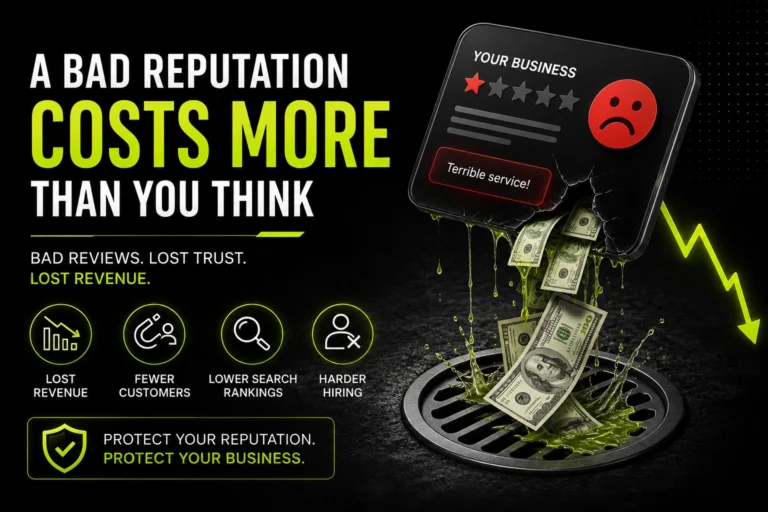
If you have ever Googled your own business name and felt uneasy about what came up, you already understand why it matters. A low star rating, an unanswered negative review, an incomplete Google Business Profile, or a damaging article sitting on page one of your search results — any one of these is costing you customers right now, quietly, every single week.
This guide explains exactly what online reputation management is, what it covers, why it matters for local businesses specifically, and what the difference is between doing it yourself and hiring a professional to manage it for you.
What Is Reputation Management and What Does It Actually Cover?
Reputation management is the practice of actively shaping what people find, read, and believe about your business online. It is not just about responding to reviews when you remember to check Google. It is a continuous, structured process that covers every platform where your reputation lives.
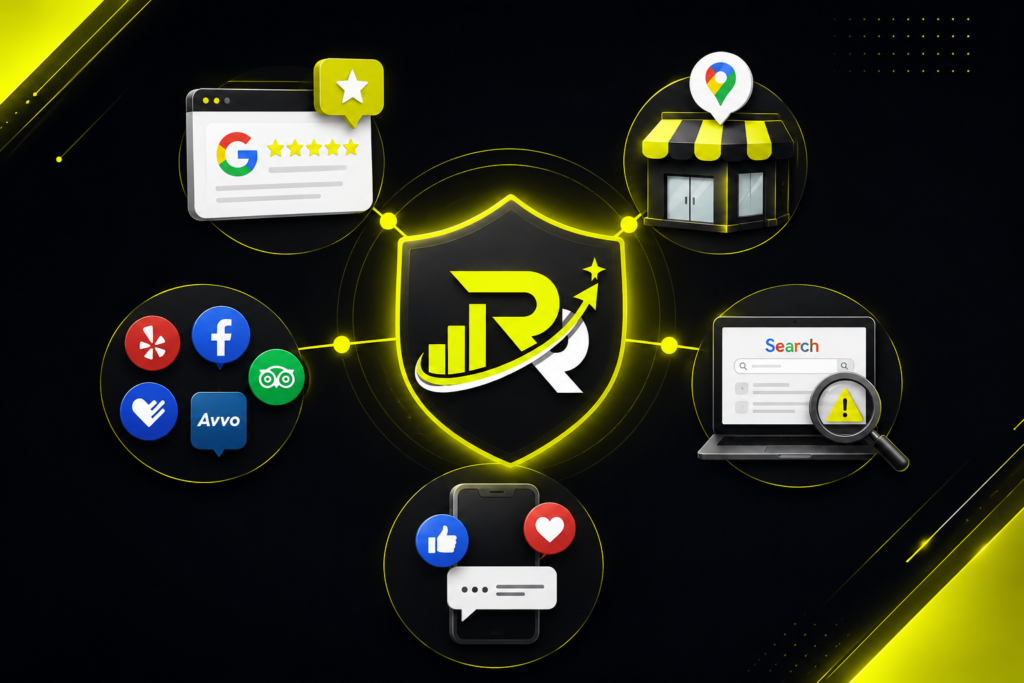
For a local business, online reputation management covers five core areas:
- Google reviews and star rating — Your rating on Google Business Profile is the most visible part of your reputation. It appears directly in search results before anyone clicks on your website. Managing it means generating new reviews consistently, responding to every review, and disputing fake or policy-violating ones.
- Google Business Profile — Your GBP controls whether your business appears in Google Maps and the local pack. An incomplete or unoptimised GBP is one of the most common and most fixable reputation problems for local businesses.
- Review platforms — Depending on your industry, customers are checking Yelp, Facebook, Healthgrades, Avvo, TripAdvisor, and dozens of other platforms before making a decision. Managing your reputation means maintaining an active, accurate presence on every platform relevant to your business type.
- Search results for your business name — When someone Googles your business name, what appears on page one tells them everything they need to know about your reputation. Negative articles, complaint forum posts, or third-party review sites with damaging content all affect your conversion rate before a potential customer ever contacts you.
- Social media presence — Comments, recommendations, and mentions on Facebook and Instagram form part of your public reputation. Unanswered complaints or negative posts on social platforms affect every potential customer who visits your profiles.
Why Online Reputation Management Matters for Local Businesses?
Large corporations have marketing teams, PR agencies, and legal departments managing their reputation. Local businesses, a dental practice, a plumbing company, a restaurant, a law firm — have none of that. They also tend to be far more vulnerable to a single negative review or a damaging search result because their total review volume is lower and their customer base is geographically limited.
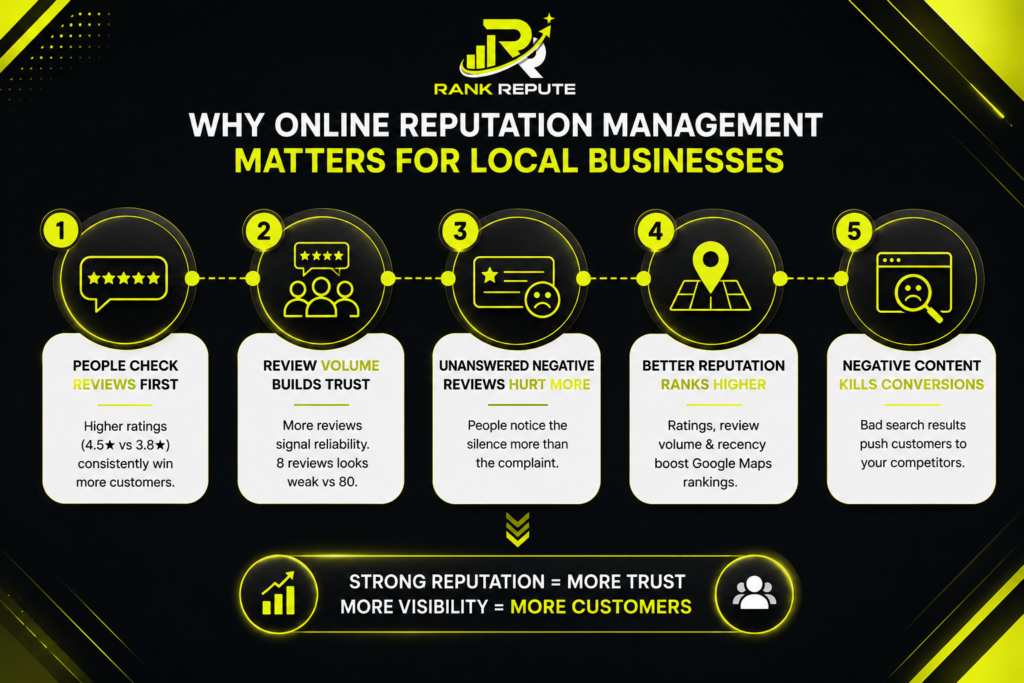
Here is why it matters in practical terms:
- Most people check online reviews before choosing a local business. A business with a 4.5-star rating consistently wins more customers than a competitor with a 3.8-star rating — even if both businesses offer identical quality.
- Review volume matters as much as rating. A practice with 8 reviews looks unestablished compared to a competitor with 80. Potential customers use review volume as a trust signal.
- A single unanswered negative review is more damaging than the review itself. Potential customers read the response or notice the absence of one before deciding whether to trust your business. Businesses dealing with fake feedback often look for ways to remove fake Google reviews before it affects customer trust.
- Google Maps rankings are directly affected by reputation signals. Your star rating, review volume, and review recency are ranking factors. A business with a stronger reputation signals ranks higher in local search, which means more visibility and more enquiries.
- Negative content in search results kills conversions. If someone Googles your business name and finds a complaint forum post or a damaging article on page one, most potential customers will move on without contacting you.
The Main Components of Online Reputation Management
Online reputation management works best when every part of your digital presence is managed together instead of separately. From customer reviews and search visibility to brand trust and social engagement, each component directly affects how potential customers perceive your business online. Professional ORM services combine review strategy, local visibility, monitoring, and brand protection into one complete system that helps businesses build stronger trust and attract more customers.
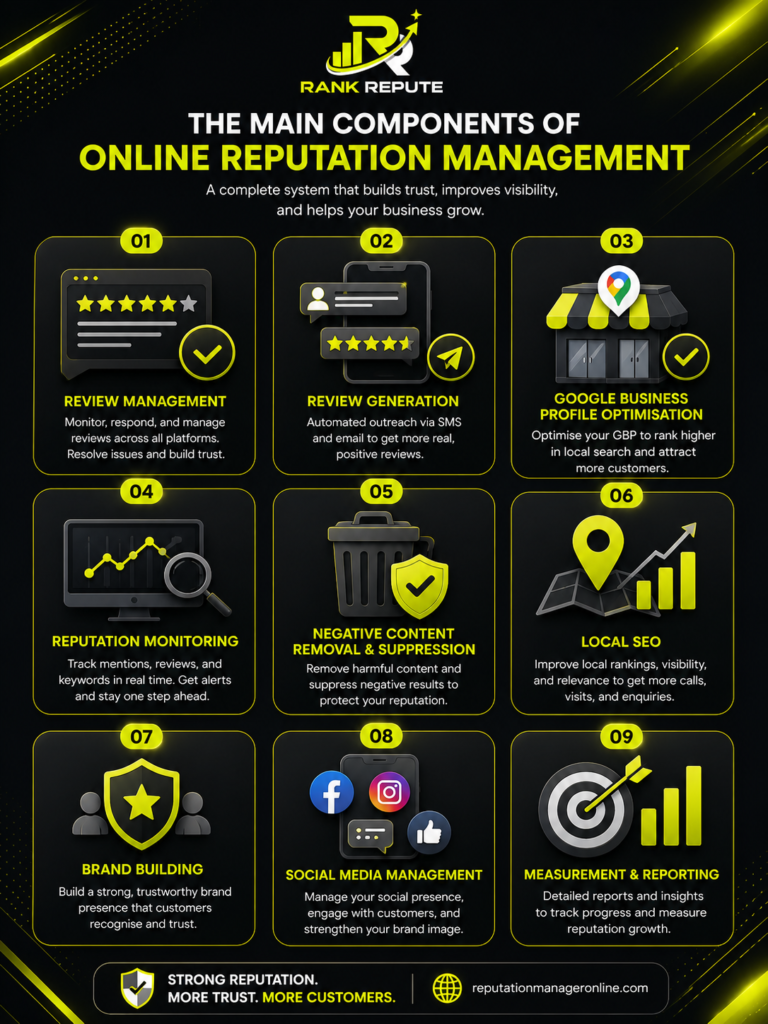
Review Management
Review management is the most active and ongoing part of online reputation management for local businesses. It covers monitoring every new review across all platforms, responding to reviews within 48 hours, flagging and reporting fake or policy-violating reviews, and generating new genuine reviews consistently through compliant outreach campaigns.
Most local businesses handle review management reactively, checking Google occasionally, responding to some reviews, ignoring others. A structured review management system does the opposite: it monitors in real time, responds to everything, and generates new reviews systematically every month.
Review Generation
Getting new reviews is not something that happens on its own at scale. Most satisfied customers do not leave reviews unless prompted. Professional review generation systems help businesses consistently collect authentic customer feedback through automated outreach campaigns. A review generation system sends automated, policy-compliant review requests to customers via SMS and email after every transaction or appointment, turning satisfied customers into five-star reviews consistently without any manual effort from the business owner.
Google Business Profile Optimisation
Your Google Business Profile is the single most important local ranking factor. An optimised GBP has correct business categories, complete service listings, professional photos, accurate hours, regular posts, and active Q&A management. Most local businesses have at least three to five fixable GBP issues silently suppressing their local search ranking.
Reputation Monitoring
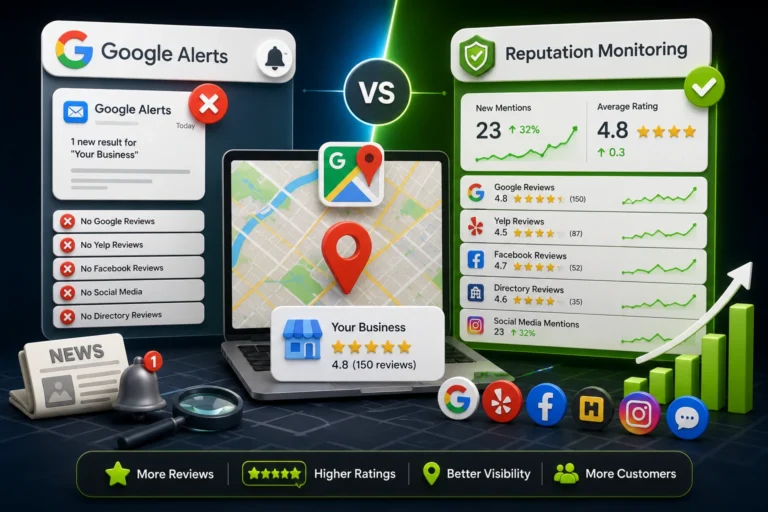
You cannot manage what you are not tracking. Reputation monitoring means watching every platform where your business is mentioned — review sites, social media, news sites, directories, and search results — in real time. A monitoring system alerts you immediately when a new review is posted, when your business is mentioned in an article, or when new negative content appears in search results for your business name.
Negative Content Removal and Suppression
Some reputation problems go beyond reviews. A negative article, a competitor-posted fake review, a complaint forum post, or an outdated directory listing appearing on page one of your search results requires a different approach. Negative content removal involves formally requesting removal of policy-violating content through the correct channels and, where removal is not possible, suppressing harmful results by building positive content that pushes them off page one over time.
Local SEO
Local businesses with stronger reputation signals consistently perform better in Google Maps rankings. Professional local SEO improves visibility by optimising your Google Business Profile, location relevance, citations, and local search presence. When reputation management and local SEO work together, businesses gain more visibility, more clicks, and more enquiries from nearby customers.
Brand Building
A strong online reputation is built over time through consistent visibility and trust signals. Strategic brand building helps businesses strengthen their authority across search results, review platforms, and digital channels. This creates a more credible online presence that improves customer confidence before they ever make contact.
Social Media Management
Social media activity directly affects how customers perceive your business online. Professional social media management helps businesses maintain a consistent brand image across Facebook, Instagram, and other platforms by managing engagement, monitoring comments, and responding to customer interactions in a timely manner.
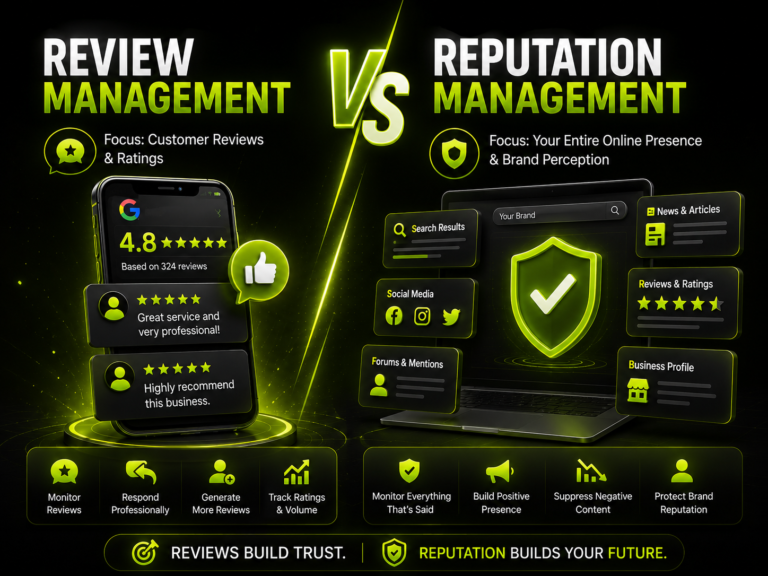
Review Management vs Reputation Management — What Is the Difference?
This is one of the most common points of confusion for local business owners.
Review management is one component of online reputation management. It covers your reviews — monitoring them, responding to them, generating new ones, and disputing fake ones.
Online reputation management is the complete picture. It includes review management plus Google Business Profile optimisation, search result management, negative content removal, citation consistency, brand building, and social media reputation monitoring.
A business that only manages its reviews is doing one-fifth of what a complete ORM strategy covers. The businesses that consistently dominate local search results and maintain the strongest reputations in their markets are managing all five components, not just their Google reviews.
Who Needs Online Reputation Management?
Any local business that depends on customers finding and choosing it online needs some form of reputation management. The need is most urgent for businesses in these situations:
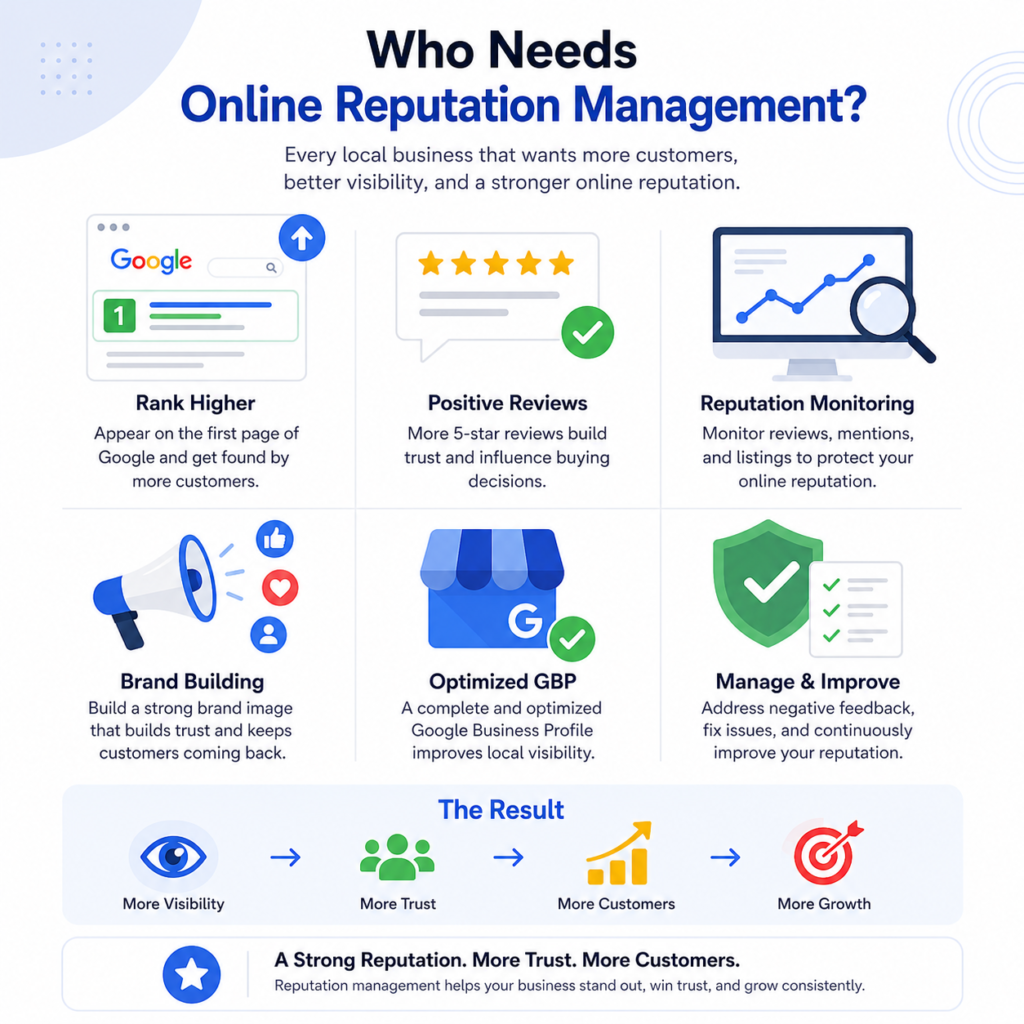
- Your Google rating is below 4.0 stars
- You have fewer than 20 reviews on Google
- You have unanswered negative reviews visible on your profile
- A competitor in your area has significantly more reviews or a higher rating than you
- Your Google Business Profile is incomplete or has incorrect information
- Negative content appears on page one of Google search results for your business name
- You have no system for generating new reviews consistently
If any of these apply to your business, your reputation is actively costing you customers. The good news is that all of them are fixable with the right system in place.
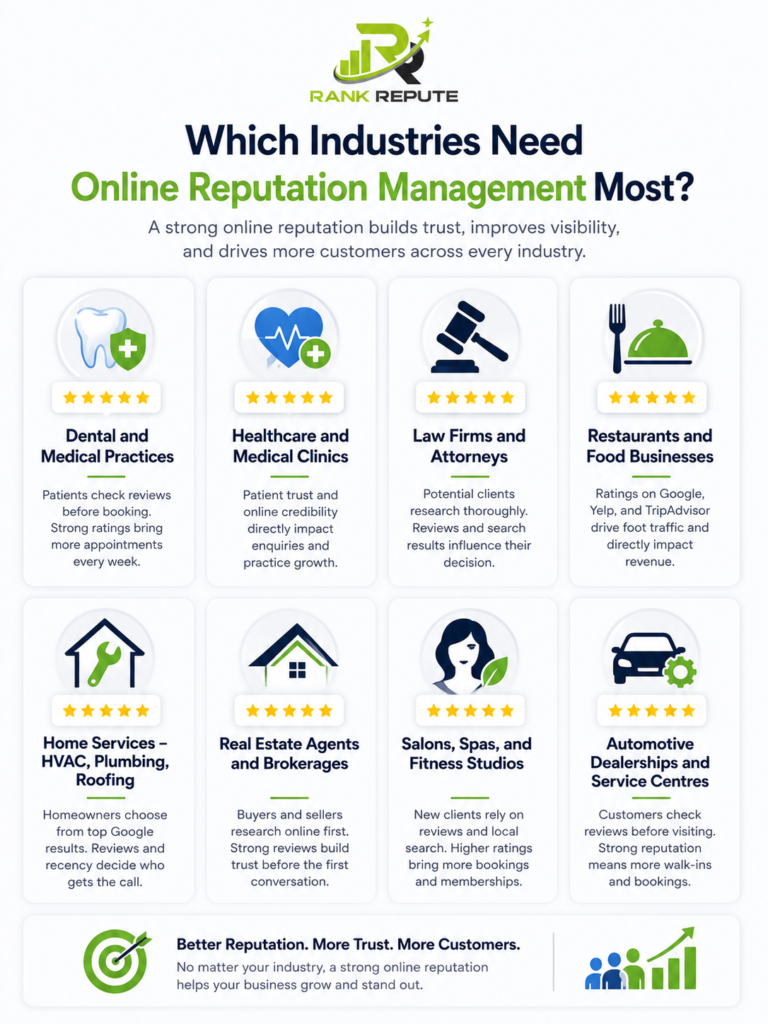
Which Industries Need Online Reputation Management Most?
Online reputation management matters for every local business — but some industries are more directly affected by their online reputation than others. Businesses across different industries served rely heavily on customer trust, review ratings, and local search visibility to generate consistent revenue. These are the sectors where a strong or weak reputation has the most measurable impact on revenue.
Dental and Medical Practices
Patients check Google and Healthgrades before booking any appointment. A rating below 4.0 stars or an incomplete Healthgrades profile costs medical and dental practices new patient bookings every single week. Professional dental reputation management helps practices improve patient trust, review ratings, and local search visibility.
Healthcare and Medical Clinics
Healthcare providers depend heavily on patient trust and online credibility. Professional healthcare reputation management helps clinics maintain stronger ratings, improve local visibility, and attract more patient enquiries through positive online reputation signals.
Law Firms and Attorneys
Potential clients research attorneys thoroughly before making contact. An incomplete Avvo profile, unanswered negative reviews, or damaging content in search results eliminates a law firm from consideration before the first conversation. Professional legal reputation management helps law firms improve trust, manage reviews, and strengthen their online visibility.
Restaurants and Food Businesses
Google, Yelp, and TripAdvisor ratings drive foot traffic directly. Research consistently shows that even a half-star difference in rating affects revenue meaningfully for restaurants competing in the same area.
Home Services — HVAC, Plumbing, Roofing
Homeowners searching for contractors in Google Maps pick from the top three results. Review volume and recency are the dominant factors in who ranks there and who gets called.
Real Estate Agents and Brokerages
Buyers and sellers research agents on Google, Zillow, and Realtor.com before making contact. A strong review profile builds trust before the first conversation happens.
Salons, Spas, and Fitness Studios
New client acquisition in these industries runs almost entirely on online reviews and local search visibility. A competitor with more reviews and a higher rating consistently wins new clients over a lower-rated business nearby.
Automotive Dealerships and Service Centres
Car buyers and service customers check Google and DealerRater before visiting. A dealership with a strong, actively managed review profile converts more walk-ins and service bookings than one with an unmanaged reputation.
DIY Reputation Management vs Hiring a Professional
| DIY Reputation Management | Professional ORM Service | |
|---|---|---|
| Review monitoring | Manual — you check when you remember | Real-time alerts across 50+ platforms |
| Review responses | Written by you or ignored | Written by specialists within 48 hours |
| Review generation | Occasional manual requests | Automated campaigns every month |
| GBP management | Set up once, rarely updated | Actively managed every month |
| Negative content | No system for removal | Formal removal requests and suppression |
| Time required | 3 to 5 hours per week | Zero — fully managed |
| Consistency | Depends on how busy you are | Same standard every month |
| Cost | Free but time-intensive | From $297/month fully managed |
The core difference is consistency. DIY reputation management works when you have time to focus on it — which for most business owners means it does not work consistently. A professional ORM service runs the same process every month, regardless of how busy the business is, which is what produces results over time.
How Much Does Online Reputation Management Cost?
Online reputation management costs between $297 and $10,000 per month, depending on the scope of services and the type of provider.
- Enterprise ORM agencies charge $3,000 to $10,000 per month. They serve large corporations and national brands dealing with complex, multi-channel reputation crises.
- DIY software platforms like Birdeye, Podium, and BrightLocal cost $99 to $500 per month. These are tools — you do all the work yourself.
- Managed ORM agencies for local businesses like Rank Repute, which charge $297 to $997 per month. A team manages everything for you at a price built for local business budgets.
For a single-location local business, a managed ORM service in the $297 to $597 per month range covers everything — review generation, review management, GBP optimisation, monitoring, and reporting. See the full breakdown on our pricing page.
Frequently Asked Questions About Online Reputation Management
Q: What is online reputation management and why does it matter?
Online reputation management is the process of monitoring, improving, and protecting what people find when they search your business name online. It matters because most customers research a business online before making contact — and your star rating, review volume, Google Business Profile completeness, and search results all directly affect whether they choose your business or a competitor.
Q: What does an online reputation management company do?
An online reputation management company monitors your review profiles across all relevant platforms, generates new reviews through compliant outreach campaigns, responds to every review on your behalf, optimises your Google Business Profile, reports and disputes fake or policy-violating reviews, removes or suppresses damaging content in search results, and provides monthly reporting on your reputation performance. A managed ORM service does all of this without any involvement required from the business owner.
Q: How much does online reputation management cost?
Online reputation management costs between $297 and $10,000 per month. For local businesses, a fully managed service from a specialist agency typically costs between $297 and $997 per month depending on the scope of services and number of locations. DIY software platforms cost less but require the business to manage everything themselves. Enterprise agencies charge significantly more but serve large corporations, not local businesses.
Q: How long does it take to see results from reputation management?
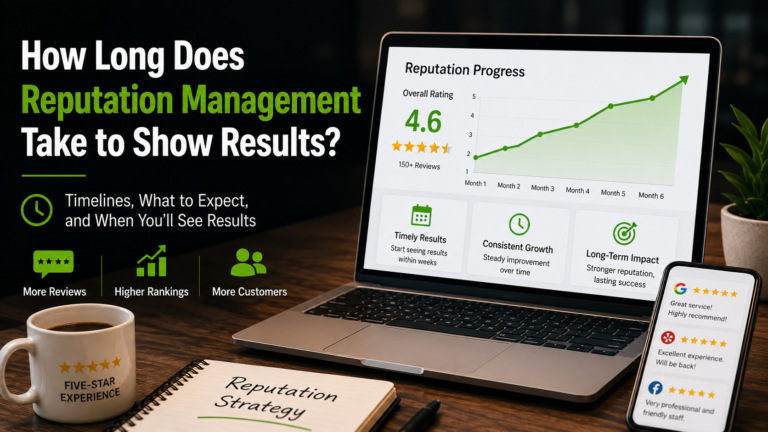
Most local businesses see their first new reviews within 30 days of starting a managed reputation campaign. Measurable improvement in overall star rating typically happens within 60 to 90 days. Google Maps ranking improvement follows as review signals and GBP optimisation take effect. Suppressing negative search results takes 3 to 6 months depending on the volume and authority of the content.
Q: Is online reputation management only for big companies?
No. Online reputation management is arguably more important for local businesses than for large corporations. A local dental practice, restaurant, or law firm with 15 reviews and a 3.7-star rating is far more vulnerable to a single negative review than a national brand with thousands of reviews and a dedicated PR team. Local businesses operate in geographically limited markets where losing even a handful of potential customers per month to a lower-rated competitor represents a significant revenue impact.
Conclusion
Online reputation management is not a luxury for large businesses with marketing budgets. For any local business that depends on customers finding and choosing them online, it is one of the highest-return activities available.
The businesses consistently winning in local search — appearing in the Google Maps top three, converting searchers into customers, and growing their review profiles month after month — are not doing anything complicated. They have a system that monitors their reputation, generates reviews consistently, responds to every piece of feedback, and fixes problems before they compound.
If you want to see exactly where your reputation stands right now — your rating, your review volume, your GBP completeness, and how you compare to your top three local competitors — start with a free reputation audit from Rank Repute. Delivered within 48 hours, no cost, no obligation.