Google Alerts vs Reputation Monitoring: What Local Businesses Actually Need
Quick Answer
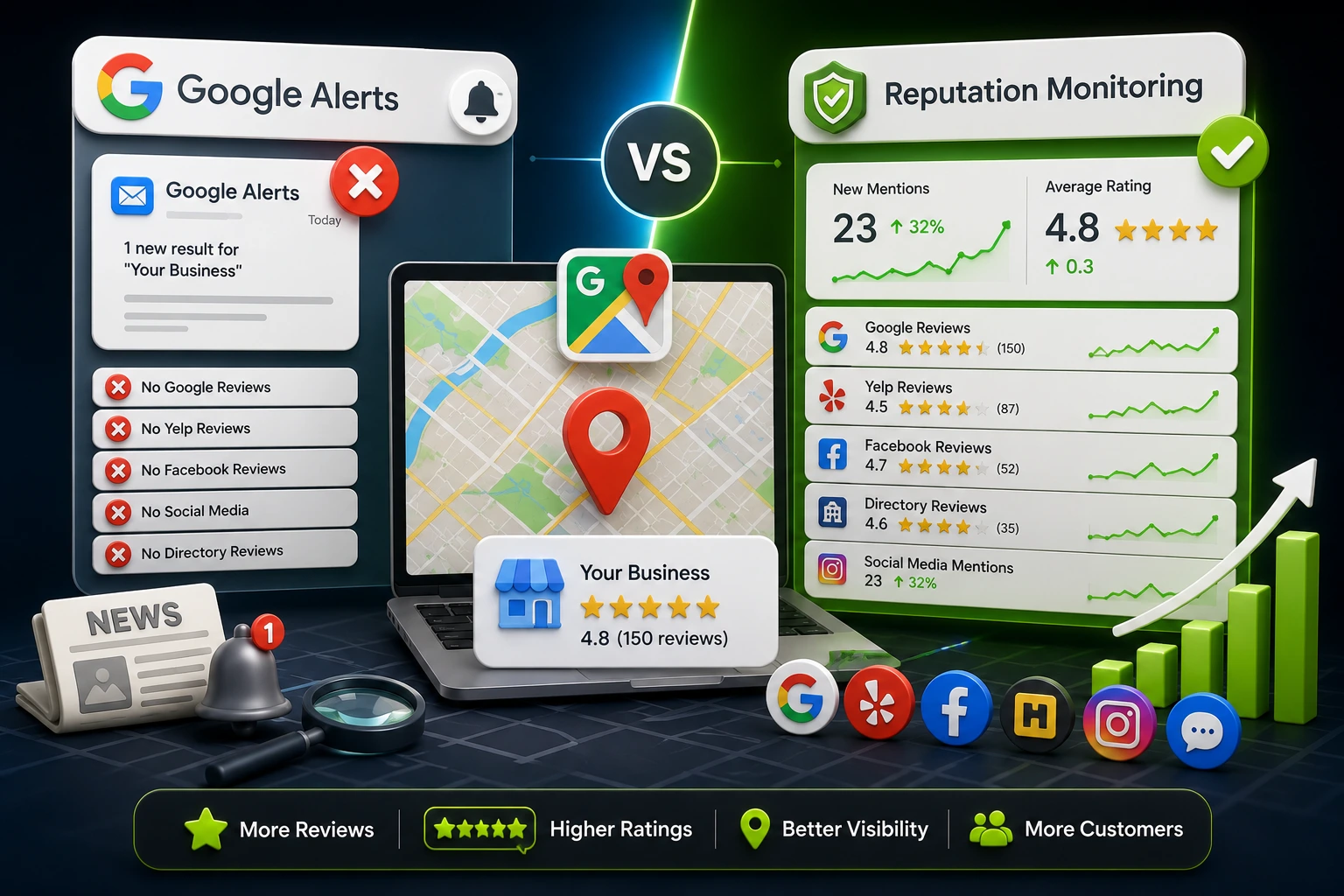
Google Alerts is a free tool that sends you an email when your business name appears in a news article or web page. It does not monitor Google reviews, Yelp, Facebook, or any review platform. For a local business, those review platforms are where your reputation is built or damaged every single day. Google Alerts alone is not enough.
Google Alerts is a useful news monitoring tool, but it does NOT monitor Google reviews, Yelp reviews, Facebook reviews, or industry-specific directories. For a local business, reputation monitoring means tracking all of these, not just news mentions.
Most local business owners set up Google Alerts, get an occasional email, and assume their reputation is being watched. It is not. The one-star review left on Google last Tuesday, the complaint posted on Yelp this morning, the negative comment on your Facebook page three days ago — none of these reach you through Google Alerts.
This article explains exactly what Google Alerts does, what it misses, and what proper reputation monitoring for a local business actually looks like.
What Google Alerts Actually Monitors?
Google Alerts was built in 2003 as a simple news tracking tool. You type in a search term, and Google emails you when that term appears in a newly indexed web page or news article.
That is genuinely useful for some things. If a local newspaper writes about your business, Google Alerts will catch it. If your business name appears in a blog post or an online article, you will get notified. For large brands monitoring press coverage, it does a decent job.
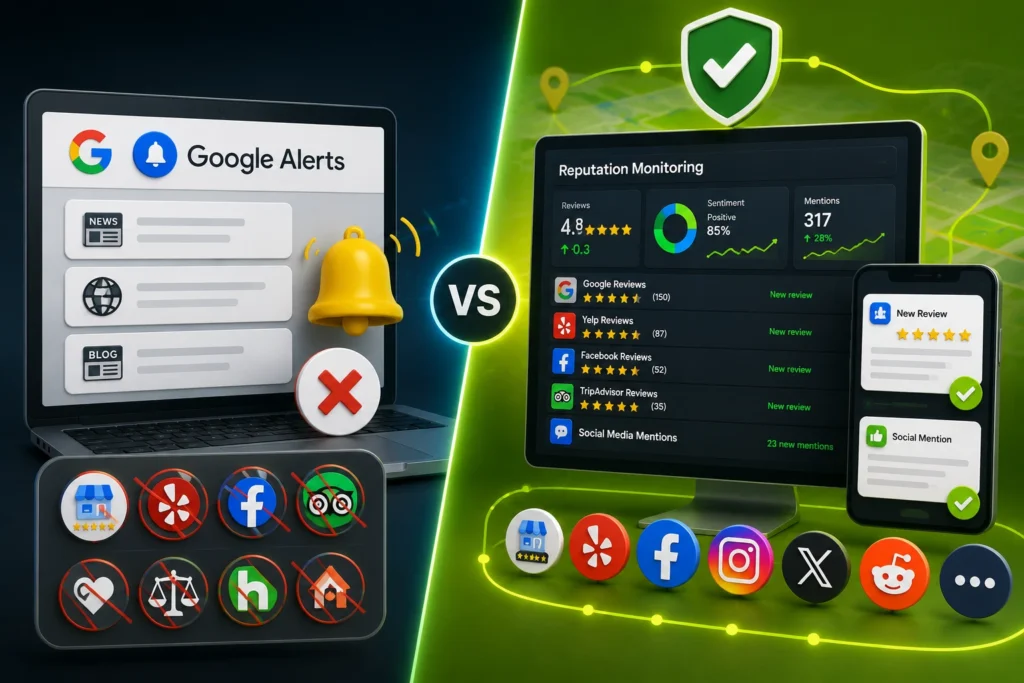
But here is what Google Alerts does not monitor:
- Google reviews on your Google Business Profile
- Yelp reviews and ratings
- Facebook reviews and recommendations
- TripAdvisor reviews
- Healthgrades, Avvo, Houzz, Angi, or any industry-specific review site
- Comments on your social media posts
- Direct messages on Instagram or Facebook
- Mentions in private Facebook groups
- Forums like Reddit or Quora
For a local business, this list of missed sources is where almost all reputation activity happens. A potential customer deciding between your dental practice and the one down the road is not reading a news article about you. They are checking your Google reviews. Google Alerts does not cover any of that.
| Platform / Signal | Google Alerts | Proper Reputation Monitoring |
|---|---|---|
| Google Reviews | No | Yes |
| Yelp Reviews | No | Yes |
| Facebook Reviews | No | Yes |
| TripAdvisor | No | Yes |
| Healthgrades / Avvo / Houzz | No | Yes |
| Industry-Specific Directories | No | Yes |
| Social Media Mentions | No | Yes |
| News and Web Mentions | Yes | Yes |
| Reddit / Quora Mentions | No | Yes |
| Search Results for Business Name | No | Yes |
| Competitor Review Tracking | No | Yes |
| Real-Time Alerts | No | Yes |
Why Google Reviews Are the Biggest Gap?
Your Google Business Profile is the first thing most people see when they search your business name. The star rating appears directly in search results, before anyone clicks on your website.
A new review posted on your Google Business Profile can affect your overall star rating within hours. If someone leaves a one-star review on a Monday morning, every person who searches your business that week sees it. If you are not monitoring your Google reviews in real time, you might not know about it for days or weeks.
By then, you have already missed the window to respond quickly. A review that sits unanswered for two weeks signals to every future reader that you either do not care or do not know it is there. Neither impression is good for business.
Google Alerts will not send you a single notification about this. It simply does not have access to Google review data.
The 7 Reputation Signals Every Local Business Needs to Monitor
Proper reputation monitoring for a local business covers seven distinct areas. Google Alerts covers, at best, parts of one.
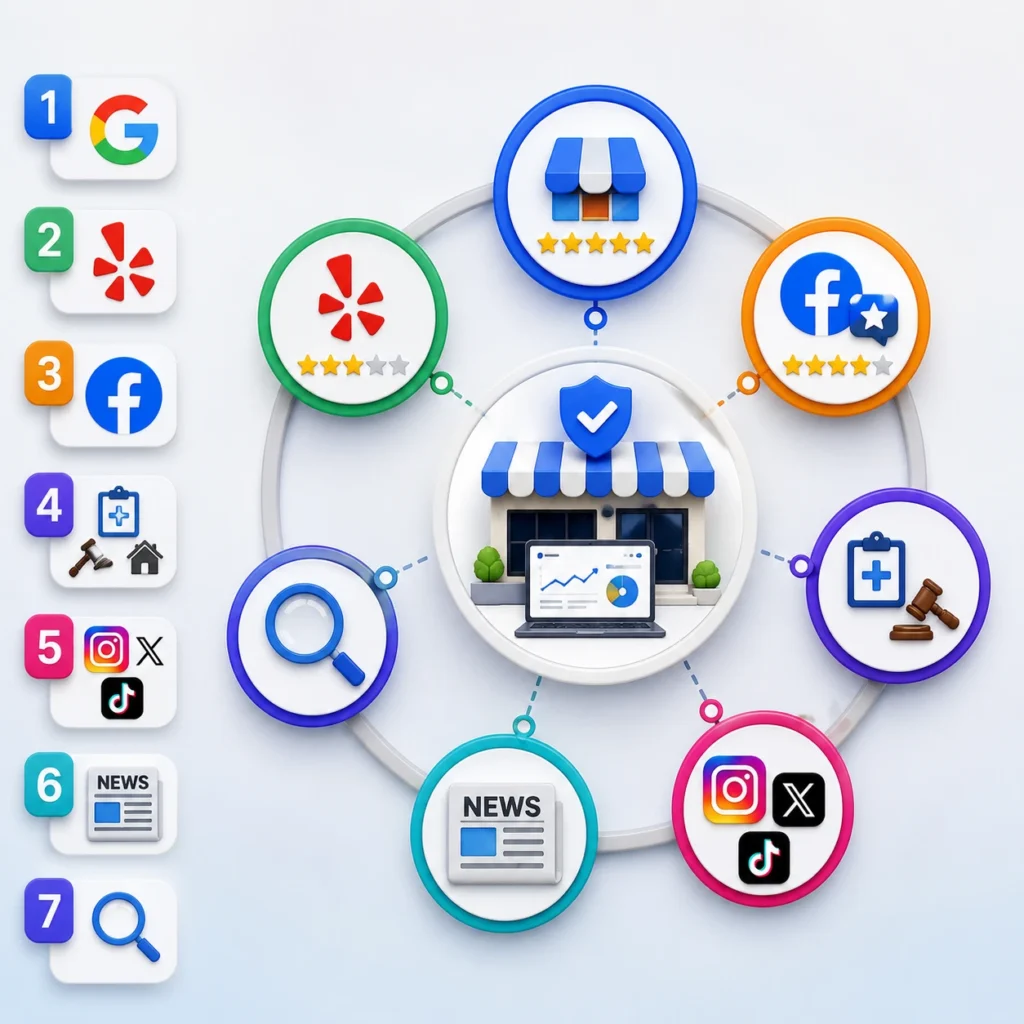
1. Google reviews
Your rating and individual reviews on Google Business Profile. This is the highest-priority signal because it appears directly in Google Search and Google Maps results.
2. Yelp reviews
Yelp remains one of the most visited review platforms in the United States, particularly for restaurants, home services, and healthcare. A three-star rating on Yelp sends customers elsewhere before they ever contact you.
3. Facebook reviews and recommendations
Facebook recommendations appear on your business page and are visible to anyone who visits. Negative recommendations on Facebook are particularly damaging because they can be shared by other users, multiplying their reach.
4. Industry-specific platforms
Depending on your business type, platforms like Healthgrades, Zocdoc, and Vitals for medical practices, Avvo and Martindale for law firms, Houzz and Angi for home services, and TripAdvisor for restaurants carry significant weight with potential customers in those industries.
5. Social media mentions
When someone tags your business on Instagram, mentions you on X, or posts about an experience on TikTok, that content is visible to their followers immediately. Without active monitoring, these mentions go unnoticed until they have already spread.
6. News and web mentions
This is the one area where Google Alerts provides some value. A local news story about your business, a blog post mentioning your services, or a forum discussion referencing your business name all appear here.
7. Search results for your business name
When someone Googles your business name, the first page of results tells them everything they need to know about your reputation. Monitoring what appears on that first page, including third-party review sites, complaint forums, and news articles, is a critical part of reputation management that most free tools do not cover.
What Proper Reputation Monitoring Includes?
Professional reputation monitoring tools and managed services cover all seven of the signals listed above, in real time, across dozens of platforms simultaneously. While monitoring provides visibility into reputation issues, businesses should also understand how long reputation management takes to set realistic expectations for improving search results, reviews, and overall brand perception.
Here is what separates a proper reputation monitoring setup from Google Alerts:
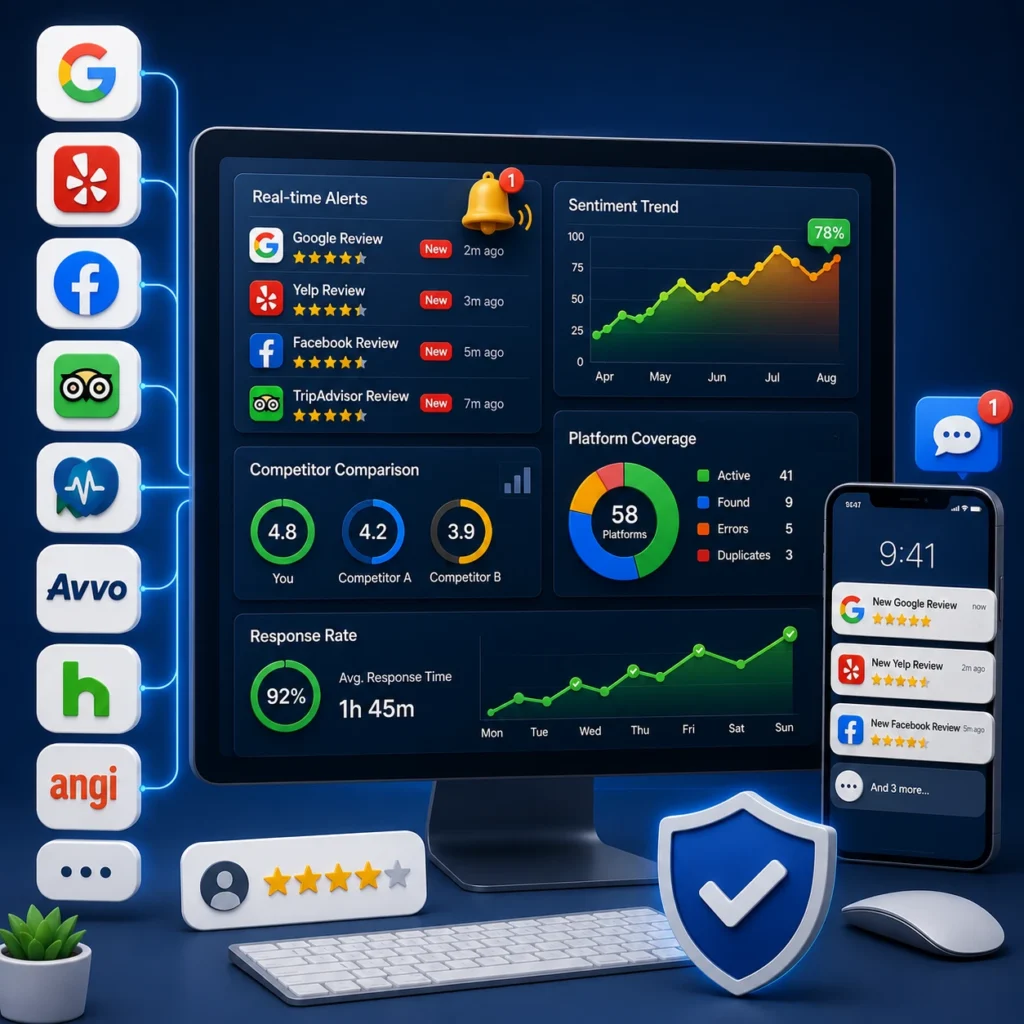
Real-time review alerts
Every new review posted on Google, Yelp, Facebook, or any monitored platform triggers an immediate notification. You know about it within minutes, not days. This matters because responding to a negative review within a few hours is dramatically more effective than responding two weeks later.
Sentiment tracking
Beyond just knowing a review was posted, a proper monitoring system tells you whether the overall sentiment around your business is improving or declining over time. A business receiving mostly positive reviews one month and mostly mixed reviews the next month has an early warning sign that something in the customer experience has changed.
Competitor monitoring
Knowing what reviews your competitors are receiving, where their ratings stand, and how their review volume compares to yours is valuable intelligence. If a competitor suddenly starts receiving a surge of five-star reviews, that is worth knowing about. If their rating drops, that is an opportunity.
Platform coverage reports
A full monitoring setup tracks your presence across 50 or more platforms and flags any new listings, incorrect information, or duplicate profiles that could be damaging your local search visibility.
Response rate tracking
Monitoring how quickly and how consistently your business responds to reviews is a reputation signal in itself. Google considers response rate as part of GBP engagement. A monitoring system that tracks your response rate helps ensure you are not falling behind.
Free Reputation Monitoring Tools: What They Can and Cannot Do
There are several free and low-cost online reputation monitoring software options beyond Google Alerts. Each has genuine uses and genuine limitations.
Google Business Profile notifications: Your GBP dashboard sends email notifications when new reviews are posted. This covers Google reviews only, but is free and reliable. It is the minimum every local business should have set up.
Yelp for Business alerts: Yelp’s business owner dashboard sends notifications for new reviews. Again, covers Yelp only. Free to use.
Facebook notifications: Facebook Page notifications cover new recommendations and comments. Free but limited to Facebook activity.
Mention (free tier): Mention monitors web and social media mentions and offers a limited free plan. It covers more ground than Google Alerts but still misses most review platforms in its free version.
BrightLocal, Podium, Birdeye: These are paid reputation monitoring platforms that cover review sites, social media, and web mentions across dozens of platforms. They range from roughly $99 to $450 per month, depending on the plan. They are tools, not managed services, meaning you still need to log in, read the reports, and take action yourself.
The gap between free tools and full monitoring is significant. Free tools give you partial coverage of individual platforms. A proper reputation monitoring setup gives you complete coverage across all platforms, with alerts, reporting, and the ability to act on what you find.
Why Review Platforms Are More Important Than News Mentions?
Here is a simple way to think about the difference between what Google Alerts monitors and what actually matters for a local business.
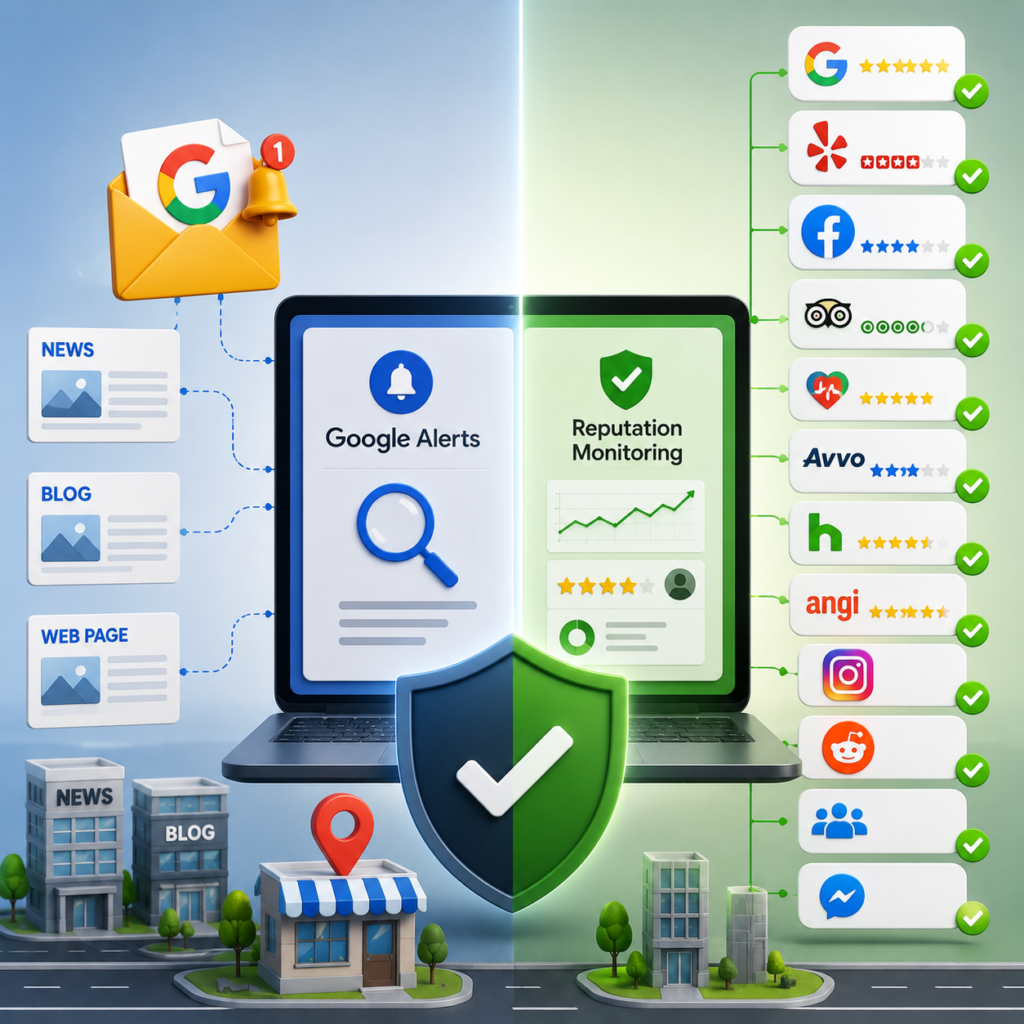
When was the last time a potential customer found a local plumber, dentist, or restaurant by reading a news article about them?
Almost never. When was the last time someone checked Google reviews before choosing a local business?
Almost always. For local businesses, reputation is built on review platforms. That is where buying decisions happen. A four-star rating with 60 reviews converts far more searchers into customers than any amount of positive press coverage. A three-star rating with 12 reviews loses customers to competitors every single day, regardless of how good the actual service is.
Google Alerts monitors the channel that matters least for local business reputation. Professional reputation monitoring covers the channels that matter most.
FAQ
Q: Is Google Alerts enough for reputation monitoring?
No. Google Alerts monitors news articles and web pages that mention your business name, but it does not track Google reviews, Yelp, Facebook reviews, or any review platform. For a local business, review platforms are where reputation is built and damaged most frequently. Google Alerts alone leaves the most important channels completely unmonitored.
Q: What does reputation monitoring software track?
Professional reputation monitoring software tracks Google reviews, Yelp reviews, Facebook recommendations, industry-specific review platforms, social media mentions, web and news mentions, and search results for your business name. More advanced tools also track competitor ratings, review volume trends, and your overall response rate across platforms.
Q: How much does reputation monitoring cost?
Free options like Google Business Profile notifications, Yelp for Business alerts, and Facebook Page notifications cover individual platforms at no cost. Paid reputation monitoring platforms like BrightLocal, Birdeye, and Podium range from roughly $99 to $450 per month. A fully managed reputation monitoring service, where a team monitors and responds on your behalf, starts at $297 per month with Rank Repute.
Q: How quickly should I respond to a new review?
Responding within 24 hours is the standard best practice for positive reviews. For negative reviews, responding within a few hours is significantly more effective. A fast, professional response to a negative review shows potential customers that you take feedback seriously. A review that sits unanswered for two weeks signals the opposite.
Q: Can I monitor my competitors’ reviews?
Yes. Professional reputation monitoring tools and managed services include competitor monitoring as part of their platform coverage. Tracking competitor ratings, review volume, and review sentiment gives you useful intelligence about your market position and flags opportunities when a competitor’s reputation weakens.
Conclusion
Google Alerts is a useful tool for one specific job: tracking when your business name appears in news articles or web content. For that narrow purpose, it works fine and costs nothing.
For a local business that needs to know what customers are saying about them across Google, Yelp, Facebook, and dozens of review platforms, Google Alerts covers almost nothing that matters. Setting it up and assuming your reputation is being monitored is one of the most common and most costly mistakes local business owners make.
Proper reputation monitoring means real-time alerts across all review platforms, competitor tracking, sentiment analysis, and the ability to respond quickly when something negative appears. If you want to see what your current reputation monitoring setup is missing, start with a free reputation audit from Rank Repute.