The Cost of a Bad Online Reputation
Quick Answer
A bad online reputation costs real money. A one-star drop in rating can cut a business’s revenue by 5% to 9%, according to Harvard Business School research. Beyond lost sales, a poor reputation raises customer acquisition costs, lowers search rankings, and makes hiring harder. Around a third of consumers avoid businesses rated below four stars, so the damage happens before a prospect ever makes contact. The good news is that most of this cost is preventable with active reputation management.
Introduction
Most owners treat a bad review or a low rating as an annoyance. It is far more than that. A poor online reputation is a recurring revenue leak, quietly redirecting customers to competitors before you ever hear from them. The loss rarely shows up on a dashboard, because it happens at the exact moment a prospect decides not to contact you. This guide puts hard numbers on the cost of a bad online reputation, from lost revenue and customer avoidance to higher hiring and advertising costs, and then shows how to reduce it through effective review management services. The figures are drawn from named studies, so you can weigh the real stakes.
What Is the Cost of a Bad Online Reputation?
The cost of a bad online reputation is the total revenue and opportunity a business loses because of negative reviews, low ratings, and damaging search results. It is not a single number. It shows up across several areas at once: lost sales, lower search visibility, higher costs to win each customer, and greater difficulty hiring staff.
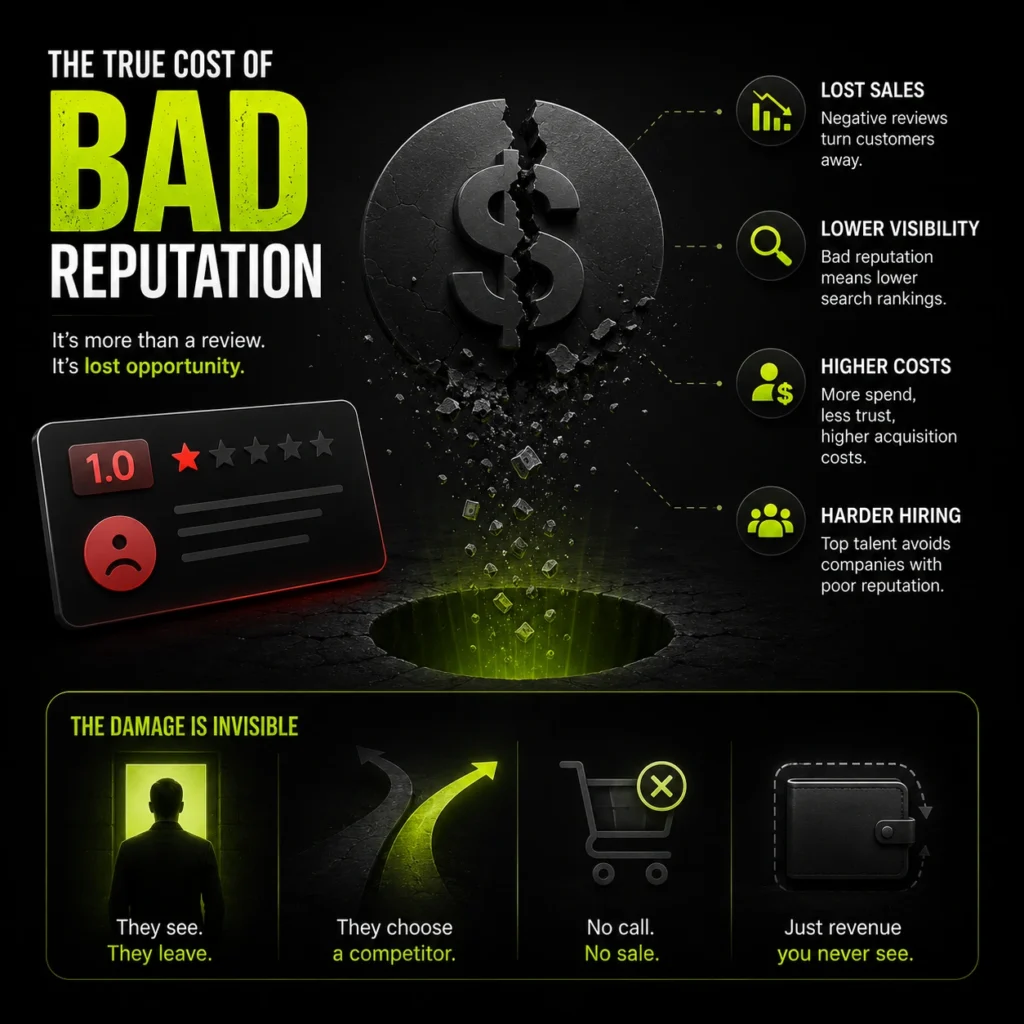
What makes it dangerous is that most of it is invisible. You do not see the customer who read a one-star review and quietly chose a competitor. There is no failed transaction to track, no complaint, no bounce. The prospect simply never arrives. That is why so many businesses underestimate the damage until it is already draining their bottom line.
How Much Revenue Does a Bad Reputation Cost?
The revenue impact is large and well-documented. Harvard Business School research found that a one-star increase in a Yelp rating leads to a 5% to 9% increase in revenue, which means a one-star drop cuts it by the same amount. Ratings move money directly.
The gap widens across the rating scale. Moving from a one-star to a three-star rating can lift revenue by around 18%, which means a restaurant with $1 million in annual revenue could lose roughly $180,000 a year to a poor reputation. Scale that up, and the numbers become severe. For a business generating $2 million a year, a one-star decline can represent between $100,000 and $180,000 in lost annual revenue, without changing the product or service at all. When losses reach this level, investing in professional reputation management often becomes a straightforward business decision, making it important to understand available reputation management pricing and the potential return on investment.
| Rating change | Approximate revenue impact | Source |
|---|---|---|
| One-star increase | +5% to 9% | Harvard Business School |
| One-star drop | -5% to 9% | Harvard Business School |
| One to three stars | ~18% swing | Harvard Business School |
| One-star drop on $2M revenue | $100k to $180k lost | ORM analysis |
How a Low Google Rating Drives Customers Away
A low rating does not just reduce revenue gradually. It removes you from consideration entirely. Around 33% of consumers actively avoid businesses rated below four stars, refusing to give them a chance at all. That four-star line is a hard filter, not a soft preference.
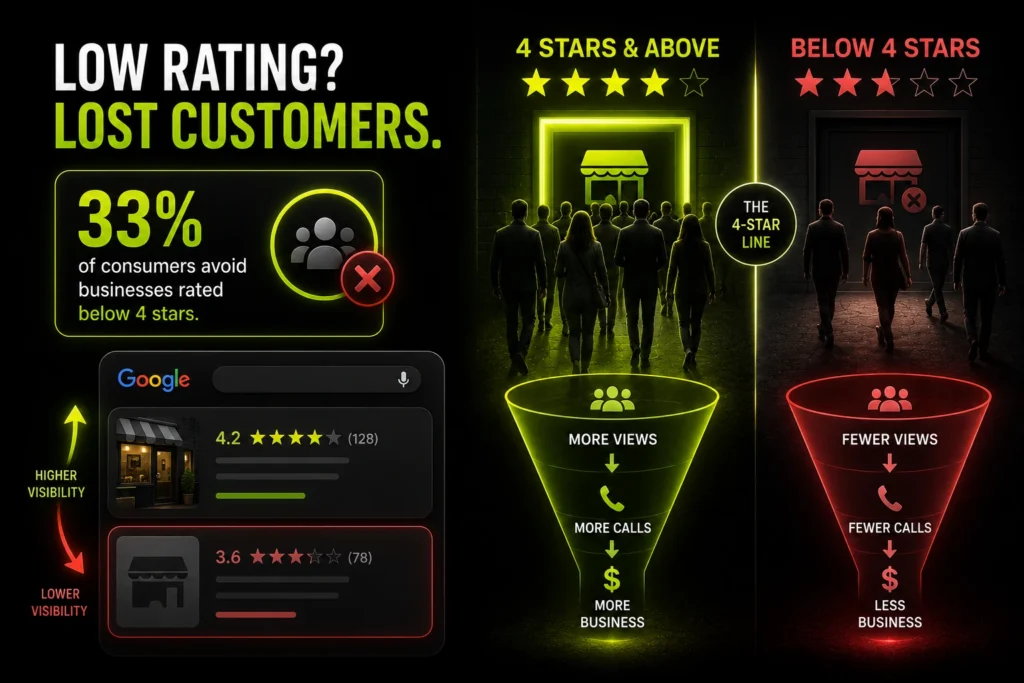
The effect is also threshold-based, which makes it sudden. Crossing a half-star boundary downward can immediately change how a listing appears in filtered search results, removing the business from consideration for a large share of the audience overnight. A slide from 4.1 to 3.8 can happen in days after one viral complaint, but recovery takes months of steady work. Because Google uses review signals in ranking, a falling rating also lowers your visibility, so fewer people find you in the first place. The mechanics of that are covered in how reviews affect local SEO.
How Negative Search Results Cost You, Customers
Damaging content on the first page of your branded search is one of the most expensive reputation problems, because it hits every prospect who looks you up. Moz research found that a single negative result on page one can drive away about 22% of prospective customers, two negative results push that to around 44%, and three reach roughly 59%. The Washington Post
That means three unflattering results on page one can suppress more than half of your potential business before anyone engages. The loss is invisible on analytics, because it happens before a session ever begins. This is why search position matters as much as the content itself, and why professional negative content removal and suppression are worth the investment when damaging results rank prominently.
| Negative results on page one | Approximate customers lost | Source |
|---|---|---|
| One | ~22% | Moz |
| Two | ~44% | Moz |
| Three | ~59% | Moz |
Which Industries Pay the Highest Reputation Cost?
Every business pays for a bad reputation, but some pay far more because trust is central to the purchase. The higher the stakes for the customer, the harder a low rating hits.
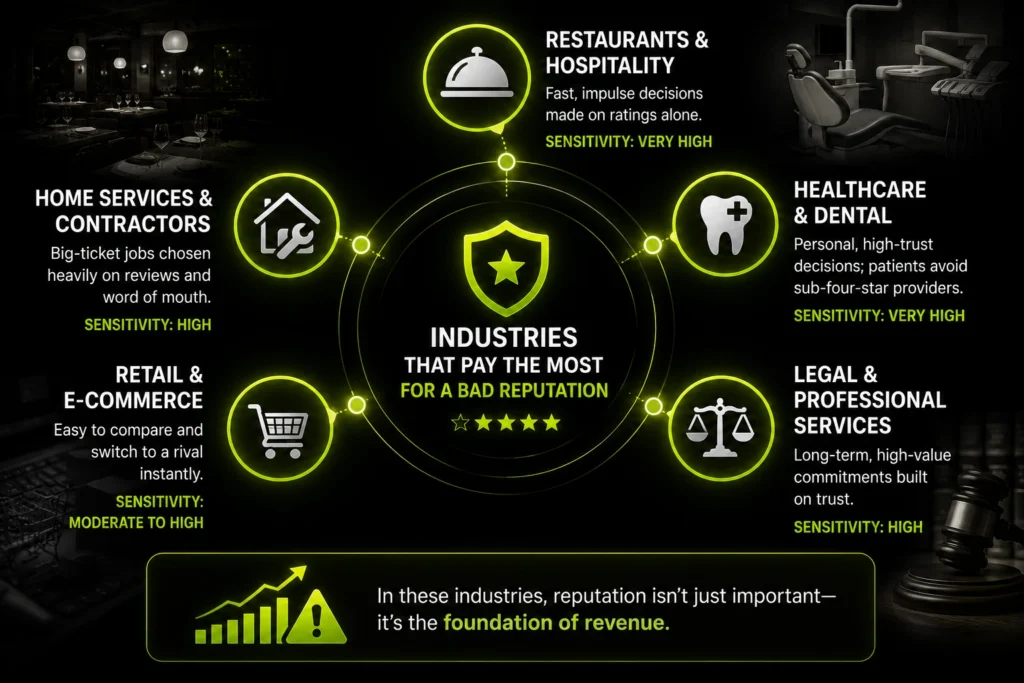
| Industry | Why is the cost high | Reputation sensitivity |
|---|---|---|
| Restaurants and hospitality | Fast, impulse decisions made on ratings alone | Very high |
| Healthcare and dental | Personal, high-trust decisions; patients avoid sub-four-star providers | Very high |
| Legal and professional services | Long-term, high-value commitments built on trust | High |
| Home services and contractors | Big-ticket jobs chosen heavily on reviews and word of mouth | High |
| Retail and e-commerce | Easy to compare and switch to a rival instantly | Moderate to high |
Restaurants feel it sharply, since Harvard Business School research showed a single Yelp star can swing revenue by 5% to 9%. Healthcare carries an even higher trust bar because most patients will not consider a provider rated below four stars. In these sectors, reputation is not a marketing concern; it is a revenue foundation. This is why industry-specific review management matters, since the cost of getting it wrong differs so much by field.
The Hidden Costs Beyond Lost Sales
The revenue you never earn is only part of the picture. A bad reputation raises costs across the business:
- Higher customer acquisition costs. When your reputation creates friction, you need more ad spend and effort to win each customer, so your cost per acquisition rises while conversion falls.
- Harder, costlier hiring. According to a CareerBuilder survey, 71% of US workers will not apply to a company with a poor reputation, shrinking your talent pool and lengthening time-to-hire.
- A damaging cycle. Fewer customers mean fewer new positive reviews, which lets existing negatives weigh more heavily, which drives away more customers. In some cases, businesses may need professional assistance to remove negative Google reviews that violate platform policies before they can begin rebuilding trust.
- Wasted marketing spend. Every pound spent driving traffic works less well when prospects arrive, check your reviews, and leave.
These costs compound quietly. They rarely appear as a line item, but together they can dwarf the visible loss in sales.
What a Bad Reputation Actually Looks Like
The cost of a bad reputation is easy to underestimate because it rarely arrives as one dramatic event. It shows up as a slow series of quiet losses that owners often blame on other things.
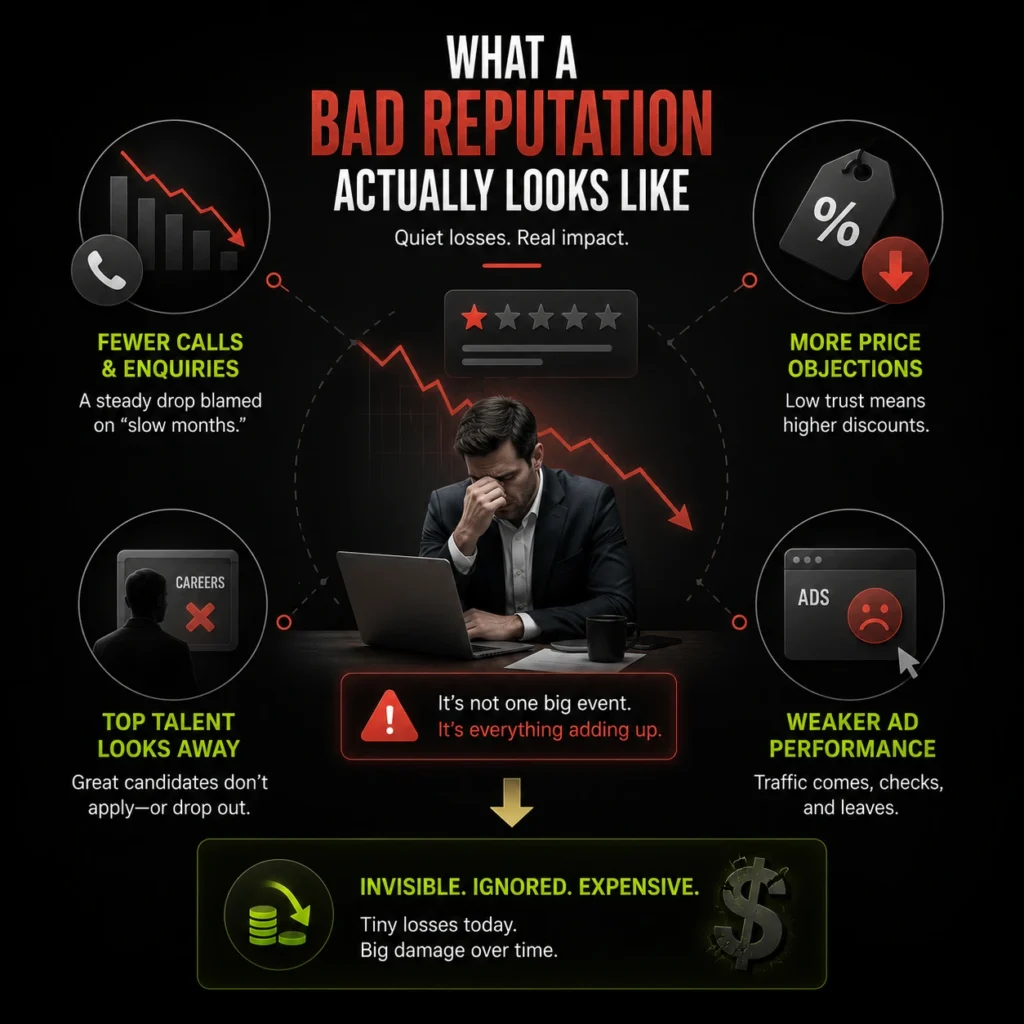
It looks like a steady drop in calls and enquiries that gets put down to a “slow month,” when the real cause is a slipping rating filtering out prospects. It looks like more price objections, because customers who do not trust your reputation need a bigger discount to feel safe choosing you. It looks like strong job candidates who never apply, or who withdraw after checking your reviews. It looks like ad campaigns that used to convert are now falling flat, because the traffic arrives, checks your profile, and leaves.
None of these shows up as a single line on a report. Each one is written off as a normal business fluctuation. Added together over a year, they represent a serious, ongoing loss, all traceable back to a reputation problem that was never addressed. One of the simplest ways to start rebuilding trust is by responding professionally and consistently to customer feedback using proven Google review response examples.
Warning Signs Your Reputation Is Costing You Money
Most businesses do not notice the cost until it is significant. These warning signs mean your reputation is already draining revenue, and each one is worth acting on early:
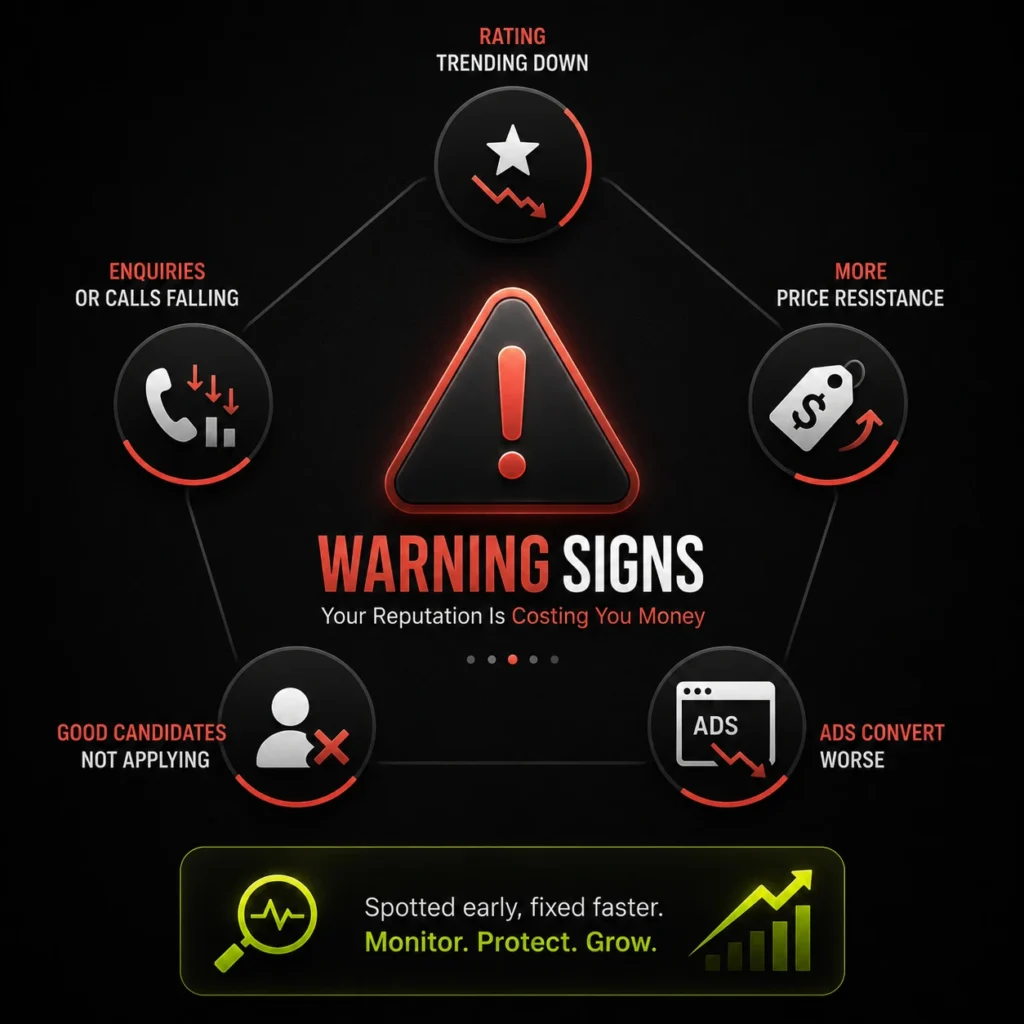
- Your average rating is trending downward. Even a slow slide toward the four-star line quietly removes you from consideration for many buyers.
- Enquiries or calls are falling without a clear reason. A drop that marketing changes do not explain often points to reputation friction.
- You are facing more price resistance. When trust is low, customers demand a bigger reason, usually a discount, to choose you.
- Good candidates are not applying. A weak employer reputation shrinks your talent pool before you ever interview.
- Your ads convert worse than they used to. Traffic that checks your reviews and leaves signals a reputation, not a targeting problem.
If two or more of these sound familiar, the cost is already real. Active reputation monitoring turns these vague symptoms into clear signals you can act on. In many cases, businesses combine reputation management with local SEO services to improve visibility, attract more qualified leads, and strengthen trust in local search results.
Why the Cost Grows Over Time
A bad reputation rarely stays the same size. It compounds. One negative review or low rating reduces trust, which lowers clicks and enquiries, which means fewer new customers and therefore fewer fresh positive reviews. With fewer positives coming in, the existing negatives carry more weight, pulling your rating and visibility down further, which repeats the cycle. What starts as a small, fixable problem becomes an entrenched one within months. This is exactly why acting early is so much cheaper than waiting, because the longer the cycle runs, the more it costs to reverse.
A Simple Illustration of the Cost
Here is how the cost adds up in practice, using conservative numbers. Say 500 people view your profile each month, and 10% were close to contacting you, giving 50 potential customers. If a visible negative review deters even 15% of them, that is around seven or eight lost contacts a month. At a $200 average transaction, that single review could be costing $1,000 to $2,000 a month in lost revenue, or well over $10,000 a year.
The exact figure varies by your transaction value, industry, and review profile. But the direction is always the same: a bad reputation is a recurring monthly cost, not a one-off event. For a precise figure tailored to your business, it helps to work out the value of your own reviews rather than rely on averages.
The Cost of Fixing Versus Preventing
Repairing a damaged reputation costs far more than protecting a healthy one. Recovery is slow and often expensive. Professional review removal services typically charge $300 to $1,500 per review, ongoing reputation management retainers often start around $2,500 to $5,000 a month, and comprehensive reputation repair can take 6 to 18 months.
Prevention costs a fraction of that. Responding to reviews, generating fresh positive feedback, and monitoring your profiles is inexpensive compared with a full recovery campaign.
| Approach | Typical cost profile |
|---|---|
| Reactive repair | High: per-review removal, large retainers, 6 to 18 months |
| Proactive prevention | Low: ongoing monitoring and review generation |
The lesson is simple. Every pound spent preventing reputation damage saves several spent fixing it later.
How to Reduce the Cost of a Bad Reputation
The good news is that most of this cost is avoidable. A few consistent habits protect your revenue:
- Respond to every review, quickly. Answering reviews builds trust and signals engagement to Google. Silence does the opposite.
- Generate positive reviews steadily. A strong flow of genuine reviews outweighs the occasional negative one. It takes roughly a dozen positive reviews to offset a single bad one, so consistent review generation matters.
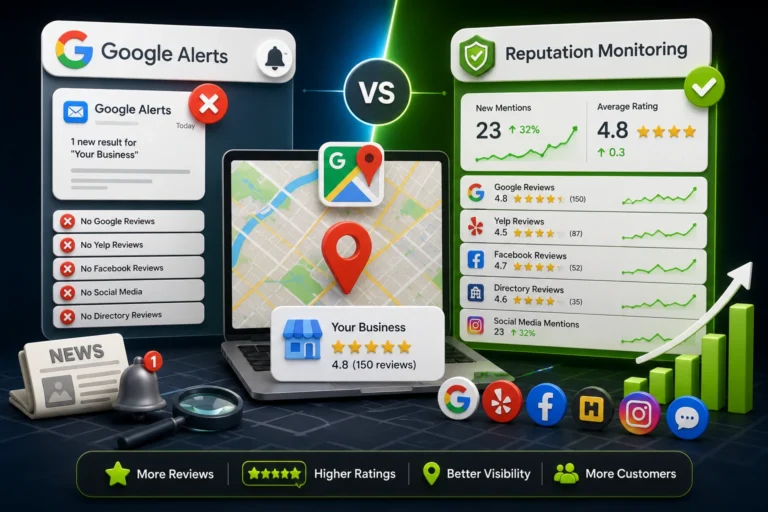
- Monitor your reputation. Catching a problem early, through active reputation monitoring, is far cheaper than reacting once it has spread.
- Address damaging search results. When negative content ranks for your name, suppress or remove it before it compounds.
Handled together, these turn reputation from a hidden liability into a managed asset. That is the core of online reputation management.
Frequently Asked Questions
How much does a bad review cost a business?
It varies, but the impact is real and recurring. A one-star drop in overall rating can cut revenue by 5% to 9%, according to Harvard Business School. For an individual review, the cost depends on your transaction value and how many prospects it deters, often adding up to thousands in lost revenue per year if left unmanaged.
How much revenue can a low Google rating lose?
Enough to threaten a small business. Around a third of consumers avoid businesses rated below four stars, so a low rating removes you from consideration entirely. Combined with the 5% to 9% revenue swing per star, a poor rating can cost a mid-sized business six figures a year.
Does a bad reputation affect more than sales?
Yes. A poor reputation raises customer acquisition costs, lowers search visibility, wastes marketing spend, and makes hiring harder, since 71% of US workers will not apply to a company with a bad reputation. These hidden costs often exceed the visible loss in sales.
How long does it take to recover from a bad online reputation?
Comprehensive reputation repair typically takes 6 to 18 months, depending on the severity and how prominently negative content ranks. Recovery is slower and more expensive than prevention, which is why ongoing management is the cheaper long-term choice.
Is reputation management worth the cost?
Almost always. Prevention costs a fraction of repair, and the revenue protected is substantial. When a single star can shift revenue by up to 9%, and a few negative search results can drive away most of your prospects, proactive reputation management usually pays for itself many times over.
Can one bad review really hurt my business?
Yes, more than most owners expect. A single negative result on the first page of your branded search can drive away around 22% of prospects, according to Moz. One review rarely sinks an established business on its own, but if it drags your rating down or sits unanswered where buyers see it, the lost revenue adds up quickly over a year.
How many good reviews does it take to cancel out a bad one?
Roughly a dozen positive reviews to offset a single negative one, though it varies by how visible and recent the bad review is. This is why steady review generation matters more than reacting to individual reviews. A strong, current flow of positive feedback keeps any one negative from defining your rating.
Does responding to negative reviews reduce the damage?
Yes. Responding professionally rebuilds trust with future readers and signals engagement to Google, which supports your ranking. Around 80% of consumers view a business more favourably when it responds to reviews. Silence does the opposite, leaving prospects to assume the worst and quietly choose a competitor.
Is it cheaper to prevent reputation damage or fix it later?
Prevention is far cheaper. Comprehensive reputation repair can take 6 to 18 months and cost thousands in removal fees and retainers, while prevention is just the ongoing cost of monitoring and generating reviews. Every pound spent protecting a healthy reputation saves several spent recovering a damaged one.
How do I know if my online reputation is Losing me money?
Watch for a falling average rating, fewer enquiries with no clear cause, more price objections, weak ad conversion, and good candidates not applying. Two or more of these usually mean reputation friction is already costing you sales. Monitoring your reviews and search results turns these vague symptoms into clear, fixable signals.
Conclusion
The cost of a bad online reputation is real, measurable, and mostly hidden. A single star can swing revenue by up to 9%, a rating below four stars removes you from a third of buyers’ consideration, and a few negative search results can suppress most of your prospects before they ever engage. On top of that sit higher acquisition costs, wasted marketing, and harder hiring. The encouraging part is that nearly all of it is preventable. Responding, generating positive reviews, monitoring, and addressing damaging content cost far less than repairing a reputation after the damage is done. If you want to know what your reputation is costing you and how to protect it, a reputation audit is the place to start.