Franchise Review Management: How to Handle Reviews Across Locations
Quick Answer
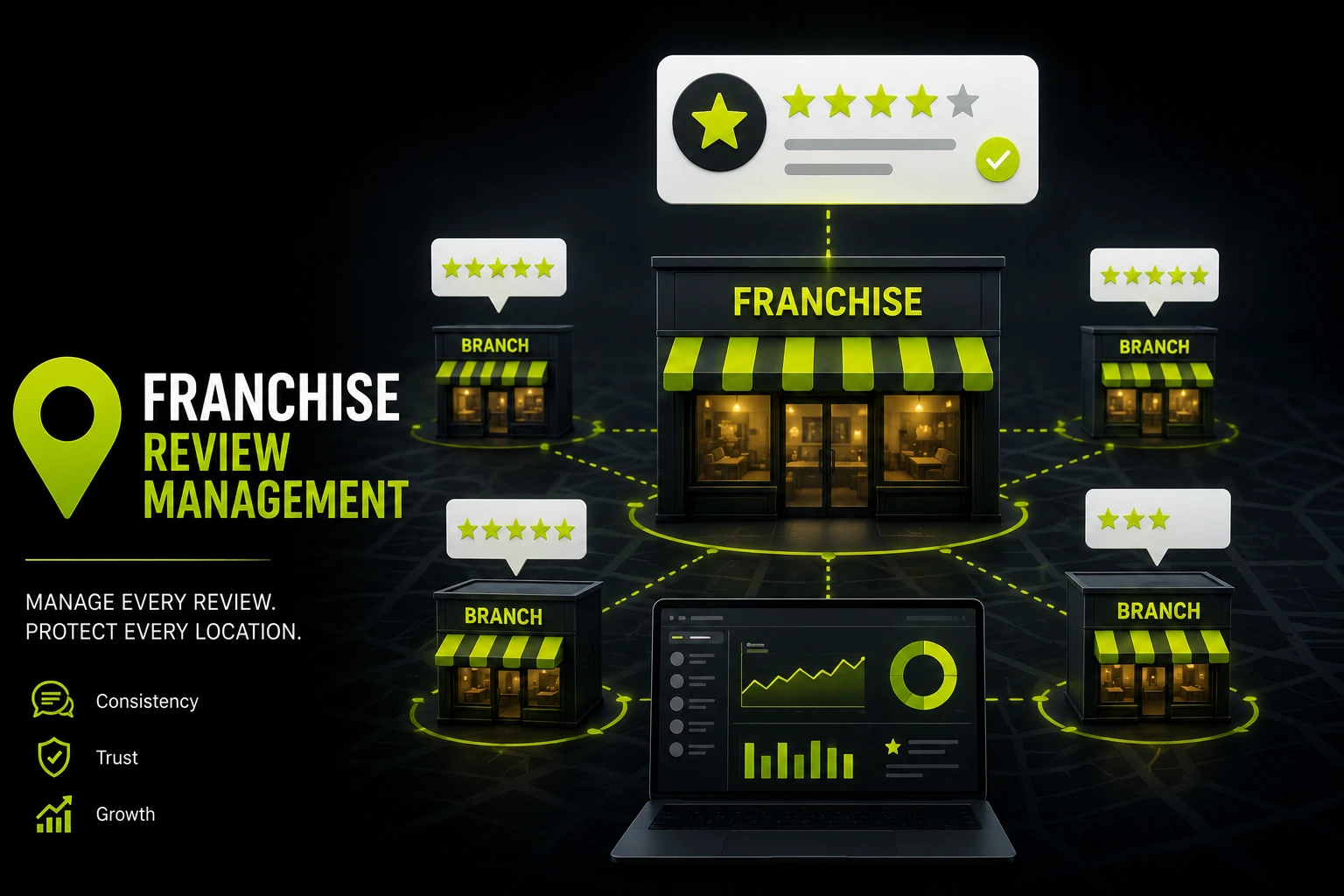
Franchise review management is the process of monitoring, responding to, and generating customer reviews across every location of a franchise, while keeping the brand consistent. It is harder than single-location review management because each outlet has its own Google Business Profile, its own reviews, and often its own owner. The best approach combines central brand control with local responsiveness, so every location protects both its own rating and the wider brand.
Introduction
A franchise lives or dies by its weakest location. A customer who reads a run of bad reviews for one outlet often judges the entire brand, not just that store. That is the core challenge of franchise review management: you are protecting one reputation spread across many doors, each with its own reviews, owner, and local market. Handle it well, and every location reinforces the brand. Handle it badly, and one poorly run outlet drags everyone down. This guide covers how franchise reviews work, the models for managing them, and the exact steps to run reviews at scale.
What Is Franchise Review Management?
Franchise review management is the coordinated handling of online reviews across all locations of a franchise brand. It covers monitoring reviews, responding to them, generating new ones, and keeping tone and quality consistent, whether the brand has five locations or five hundred.
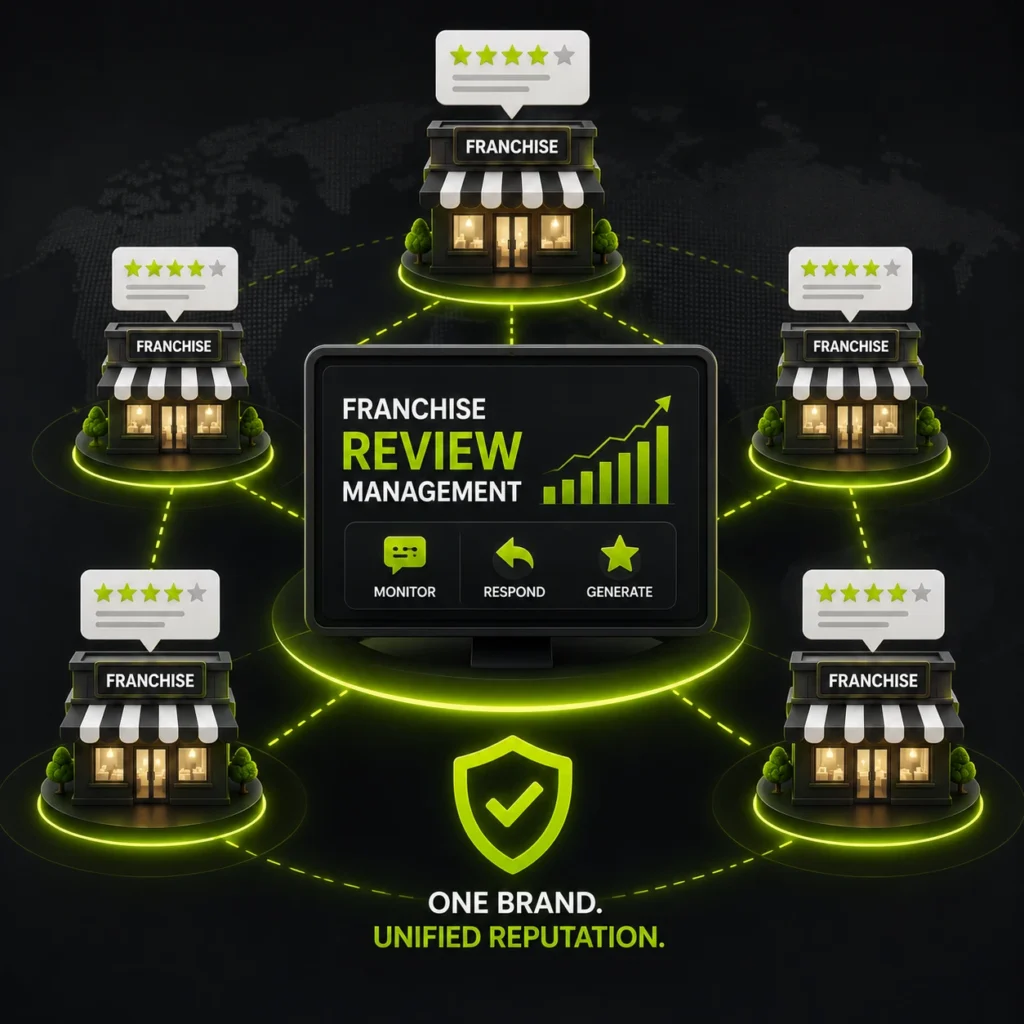
It differs from ordinary review management in one key way: scale with fragmentation. Each franchise location usually has its own Google Business Profile, its own listings on Yelp and Facebook, and often a different franchisee running it. So you are not managing one review stream. You are managing many, all tied to a single brand name. The goal is a system where every location performs to the same standard while still sounding local and genuine.
Why Franchise Reviews Are Harder to Manage
Franchise review management carries problems that single-location businesses never face. Understanding them is the first step to solving them.
- Reviews are fragmented across locations. Every outlet has separate profiles and separate ratings, so there is no single dashboard by default.
- Brand and owner interests can clash. The franchisor wants brand consistency; individual franchisees want local control. Reviews sit right in the middle.
- One weak location damages everyone. Customers generalise, so a struggling outlet lowers trust in the whole brand.
- Response quality varies wildly. Without shared guidelines, one location replies professionally while another argues or ignores reviews entirely.
- Fake reviews multiply. More locations mean more targets for competitor attacks and spam, spread across more profiles to police.
These challenges are why franchises need a defined system, not an ad-hoc effort, location by location.
Who Owns the Reviews: Centralised, Local, or Hybrid?
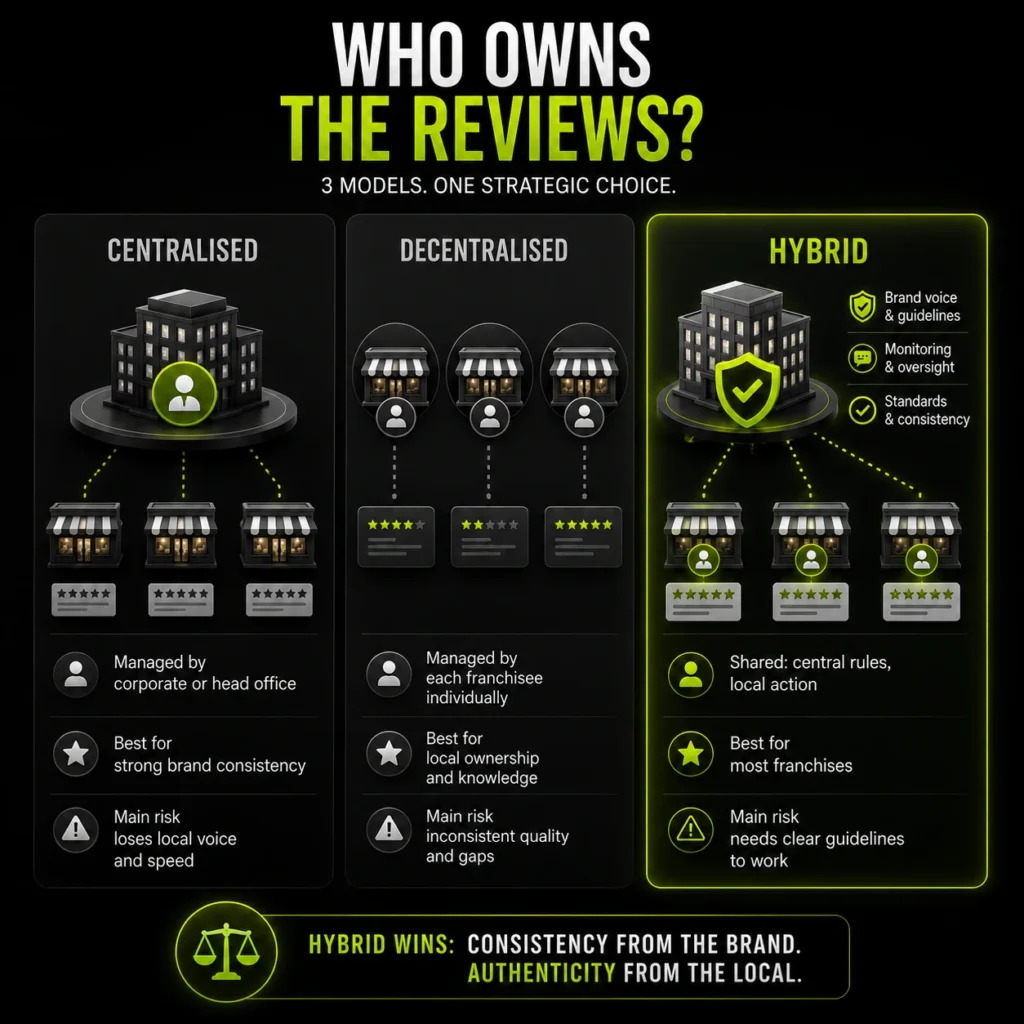
The biggest strategic decision in franchise review management is who controls the reviews. There are three models, and the right one depends on your brand’s size and structure.
| Model | Who manages reviews | Best for | Main risk |
|---|---|---|---|
| Centralised | Corporate or head office | Strong brand consistency | Loses local voice and speed |
| Decentralised | Each franchisee individually | Local ownership and knowledge | Inconsistent quality and gaps |
| Hybrid | Shared: central rules, local action | Most franchises | Needs clear guidelines to work |
Most successful franchises land on a hybrid model. The corporate sets the brand voice, response guidelines, and monitoring, while franchisees or a managed partner handle day-to-day responses with local knowledge. This balances consistency with the authentic local touch that customers trust.
How Reviews Affect a Franchise Brand
Local reviews shape how customers see the entire brand, not just one store. This is the statistic every franchisor should internalise: according to BrightLocal, around 91% of consumers say that reviews of a local branch influence their perception of the wider brand. One outlet’s reputation becomes the brand’s reputation.
Reviews also drive local discovery. Each location competes in its own local search results, and reviews are a major ranking and trust factor there. A location with strong, recent, well-answered reviews ranks higher and converts more nearby customers, which is exactly why reviews affect local SEO for every single outlet. Multiply that across dozens of locations, and review performance becomes one of the largest levers on total franchise revenue.
How to Set Up Franchise Review Management
Setting up a system across many locations follows a clear sequence. Skipping steps is what leaves gaps that reviews fall through.

- Claim and verify every location’s Google Business Profile. You cannot manage what you do not control, so confirm ownership of each profile first.
- Standardise your listings. Make sure name, address, phone, and hours are accurate and consistent across every location and platform.
- Centralise monitoring. Bring all locations’ reviews into one view so nothing is missed, wherever it is posted.
- Create response guidelines. Write a brand playbook covering tone, timing, and escalation, so every location responds to the same standard.
- Run review generation per location. Give each outlet a simple, consistent way to ask happy customers for reviews.
- Report by location and brand. Track ratings, volume, and response rates for each outlet and for the group, so you can spot weak spots early.
This structure turns scattered, inconsistent effort into a repeatable system. A managed review management partner can run this across every location, so the head office does not have to.
Common Mistakes Franchises Make With Reviews
Most franchise reputation problems come from avoidable errors that repeat across locations. Fixing these five closes the biggest gaps.
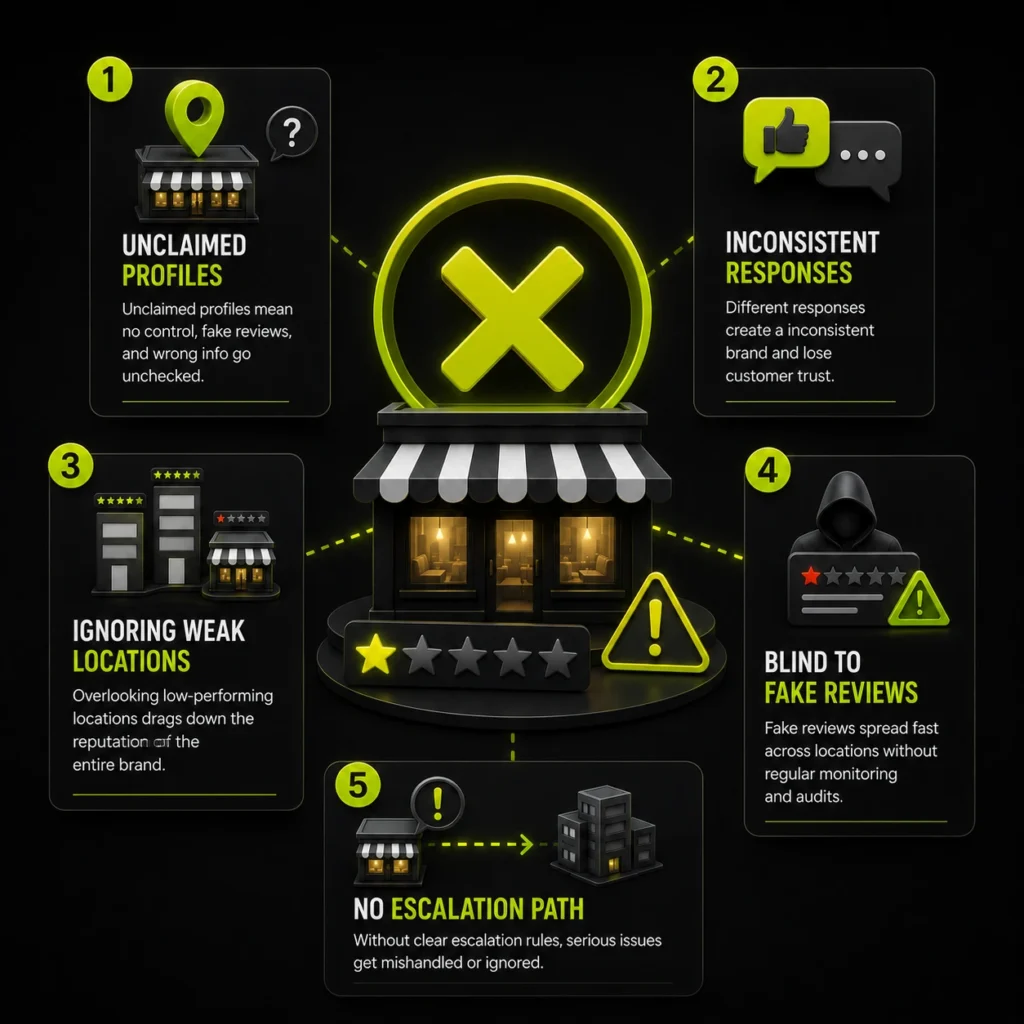
Leaving Location Profiles Unclaimed
Every unclaimed Google Business Profile is a location you cannot monitor, respond to, or protect. Fake reviews and wrong information can sit there unchecked. Claiming and verifying every profile is the non-negotiable first step, yet many franchises miss outlets entirely.
Letting Response Quality Vary by Location
When one location replies professionally, and another argues or stays silent, the brand looks inconsistent and unreliable. Customers notice. Without shared guidelines, quality depends on whichever franchisee happens to care, which is not a system.
Ignoring the Weakest Locations
Head office often focuses on top performers and overlooks struggling outlets. But a single low-rated location drags down brand trust the most, because customers generalise. The weakest doors need the most attention, not the least.
Being Blind to Fake Reviews
More locations mean more targets for competitor attacks and spam, spread across more profiles. Franchises that do not audit regularly let fake reviews distort ratings for months. Consistent monitoring is what catches them early.
Having No Escalation Path
Without a clear rule for which reviews go to head office, serious issues like safety complaints or legal threats get handled badly at the local level, or not at all. Every franchise needs a defined escalation route.
Best Practices for Managing Reviews at Scale
Once the system is set up, a few practices keep it working consistently across every location.
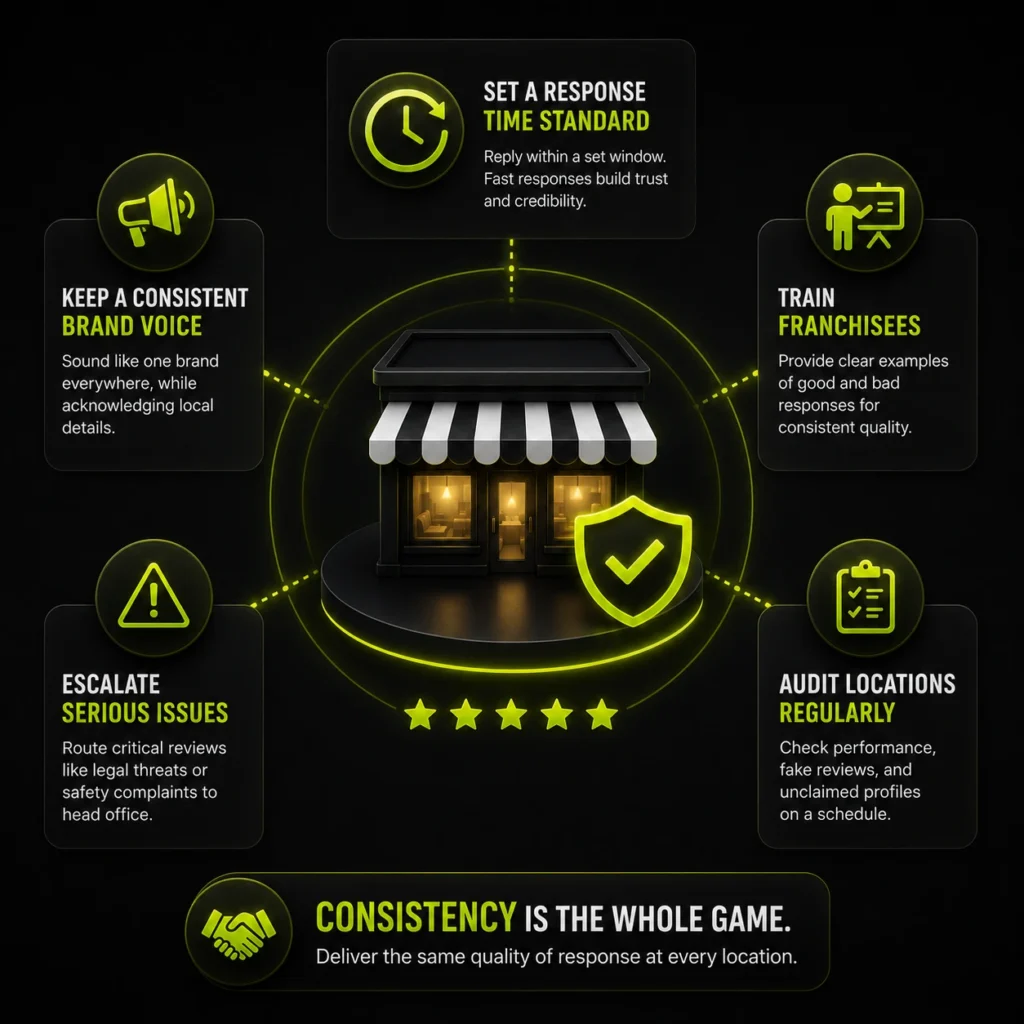
- Set a response time standard. Aim to reply to reviews within a set window, since customers expect quick responses. Reviews show that a brand that answers all its reviews earns far more trust than one that stays silent.
- Keep a consistent brand voice with local flavour. Responses should sound like the same brand everywhere, while still acknowledging local details.
- Train franchisees. Give owners clear examples of good and bad responses so quality does not depend on individual instinct.
- Escalate serious issues. Define which reviews, such as legal threats or safety complaints, get routed to head office.
- Audit locations regularly. Check for underperforming outlets, fake reviews, and unclaimed profiles on a schedule, not by accident.
Consistency is the whole game. A customer should get the same quality of response at location one and location one hundred.
How to Respond to Reviews Across Many Locations
Responding at scale means balancing brand consistency with genuine local voice. A response that sounds copy-pasted across every location reads as robotic, while a free-for-all creates wildly uneven quality.
The solution is templated flexibility. Provide franchisees with approved response frameworks for common situations, then let them personalise with local detail, the customer’s name, and the specific issue. This keeps the brand recognisable while avoiding identical replies that customers and search engines both dislike. For negative reviews, especially, a calm, solution-focused reply protects both the location and the brand, following the same principles as responding to negative reviews anywhere else.
How to Handle a Damaging Review at One Location
A serious review at a single outlet is a brand problem, not just a local one, so handle it fast and contain it early. The risk is that one location’s crisis spreads to how customers see the whole franchise.
Start by assessing the review calmly. Confirm whether it is genuine, whether it breaks platform policy, and whether it points to a real operational issue at that location. If it is fake or violates guidelines, flag it. If it is genuine, respond publicly and professionally, then move the conversation offline to resolve the actual problem. Speed matters because an unanswered serious complaint invites more of the same.
Then look past the single review. One damaging review often signals a deeper issue at that location, such as a management or service failure that will generate more complaints if ignored. Fixing the root cause protects every future customer and stops one outlet from becoming a recurring liability. The location’s rating recovers fastest when the underlying problem is solved, not just when the review is answered.
What Metrics Should Franchises Track?
Franchise review management only works if you measure it, and the right metrics show you exactly which locations need help. Tracking by location and for the group together turns vague reputation worries into clear action.
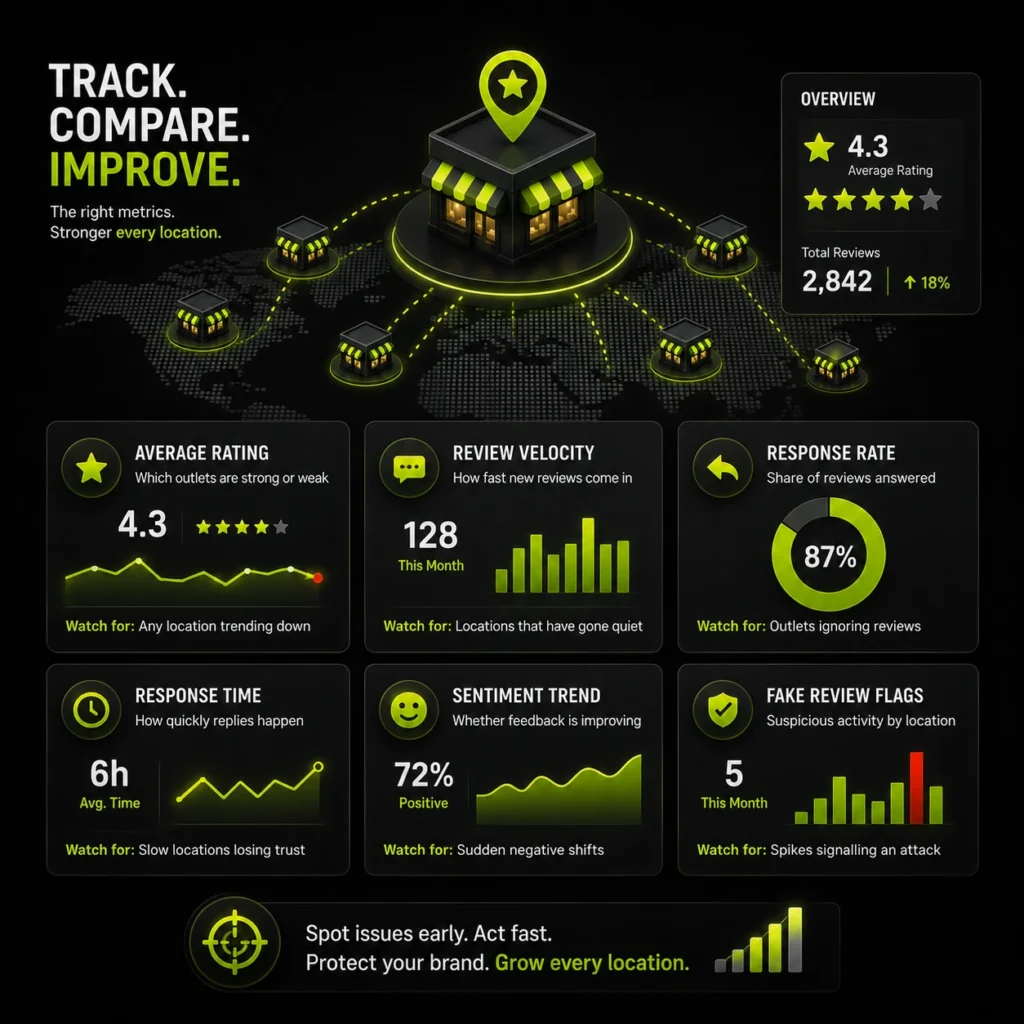
| Metric | What it tells you | Watch for |
|---|---|---|
| Average rating per location | Which outlets are strong or weak | Any location trending down |
| Review velocity | Slow locations are losing trust | Locations that have gone quiet |
| Response rate | Share of reviews answered | Outlets ignoring reviews |
| Response time | How quickly replies happen | Slow locations losing trust |
| Sentiment trend | Whether feedback is improving | Sudden negative shifts |
| Fake review flags | Suspicious activity by location | Spikes signalling an attack |
The value is comparison. When you see every location side by side, underperformers stand out immediately, and you can direct support where it actually moves the numbers. A location with a falling rating and a slow response time is a problem you can fix before it spreads.
DIY vs Managed Franchise Review Management
Franchises face a build-or-buy decision: coordinate reviews in-house, or hand the whole system to a managed partner. The right answer depends on your size and internal capacity.
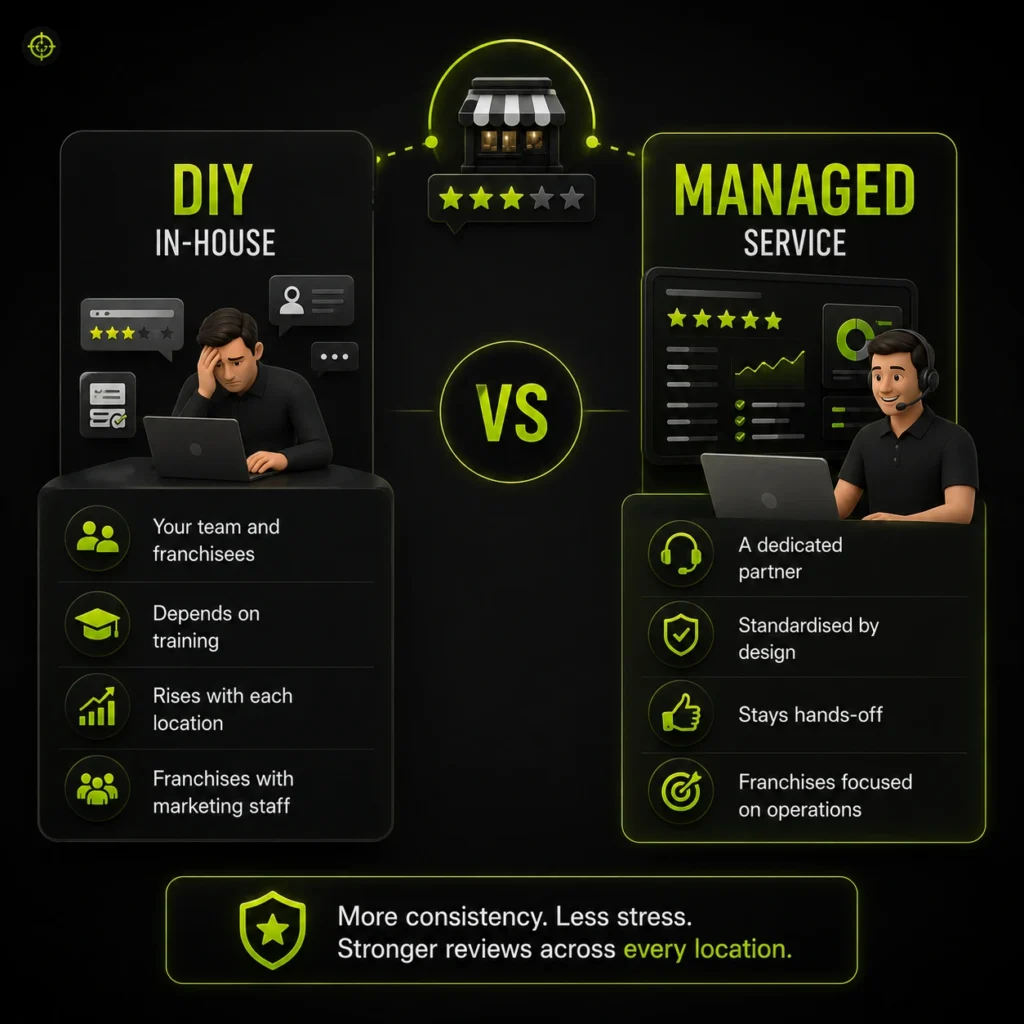
Running it in-house can work if you have a dedicated marketing team with time to claim profiles, monitor every location, train franchisees, and enforce standards. The challenge is coordination. As locations grow, so does the effort, and gaps appear the moment attention slips.
A managed service removes that burden by handling monitoring, responses, and review generation across every location for you. It suits growing franchises that would rather not build the system, train owners, and police consistency themselves.
| In-house | Managed service | |
|---|---|---|
| Who does the work | Your team and franchisees | A dedicated partner |
| Consistency across locations | Depends on training | Standardised by design |
| Effort as you scale | Rises with each location | Stays hands-off |
| Best for | Franchises with marketing staff | Franchises focused on operations |
For most multi-location brands without a dedicated reputation team, a managed reputation monitoring service is simpler and more consistent than coordinating it all internally.
Tools and Systems Franchises Need
Managing reviews across locations requires the right infrastructure, though the category matters more than any single brand. Franchises typically rely on three things working together.
First, a central monitoring system that pulls reviews from every location and platform into one dashboard, so the head office sees the full picture. Second, well-managed Google Business Profiles for each location, since Google is where most reviews and local searches happen; keeping these optimised is a core part of Google Business Profile optimisation. Third, a review generation process that every location can run the same way, so review volume grows consistently rather than depending on which franchisee remembers to ask.
The alternative to buying and running all of this yourself is a managed service that handles monitoring, responses, and generation across every location for you, which is often simpler for a growing franchise than coordinating tools and training in-house.
Frequently Asked Questions
What is franchise review management?
Franchise review management is the coordinated process of monitoring, responding to, and generating customer reviews across all locations of a franchise brand, while keeping tone and quality consistent. It combines central brand control with local responsiveness so each location protects both its own rating and the wider brand.
Why is managing reviews harder for franchises?
Because reviews are fragmented across many locations, each with its own Google Business Profile and often a different owner. Response quality varies without shared guidelines; one weak location can damage the whole brand, and there are more profiles to monitor for fake reviews. This needs a defined system, not location-by-location guesswork.
Should a franchisor or franchisee manage reviews?
Usually both, in a hybrid model. The franchisor sets the brand voice, response guidelines, and central monitoring, while franchisees or a managed partner handle day-to-day responses with local knowledge. This balances brand consistency with the authentic local touch that customers trust most.
How do bad reviews at one location affect the whole franchise?
Significantly. Around 91% of consumers say a local branch’s reviews shape their view of the entire brand, according to BrightLocal. Customers generalise, so a single poorly rated outlet can lower trust and cost applications, visits, and sales across the wider franchise.
How can a franchise get more reviews across all locations?
Give every location the same simple, consistent way to ask satisfied customers for reviews, ideally soon after service, with a direct link to that location’s profile. Standardising the process, rather than leaving it to each owner, is what grows review volume evenly across the whole brand.
How do you manage Google reviews for multiple locations?
Claim and verify every location’s Google Business Profile, then bring all reviews into one central monitoring view. Set shared response guidelines so every outlet replies to the same standard, run a consistent review generation process at each location, and report ratings by location so weak spots surface early.
What is the best review management software for franchises?
The right choice is less about a specific brand and more about three capabilities: central monitoring that pulls in every location’s reviews, well-managed Google Business Profiles per outlet, and a review generation process each location can run identically. Many growing franchises prefer a managed service over software, so the head office does not have to coordinate tools and training across locations.
Can one bad location hurt the entire franchise brand?
Yes. Around 91% of consumers say a local branch’s reviews influence how they view the whole brand, according to BrightLocal. Because customers generalise, a single poorly rated location can lower trust and cost visits, applications, and sales across every other outlet.
Who is responsible for franchise reviews, the corporate or the franchisee?
In most successful franchises, both share it through a hybrid model. The corporate sets the brand voice, response guidelines, and central monitoring, while franchisees or a managed partner handle daily responses with local knowledge. This keeps the brand consistent while responses still sound genuine and local.
How can a franchise improve its ratings across all locations?
Focus on the weakest locations first, since they damage brand trust the most. Fix recurring operational issues, respond to every review promptly, and give each outlet a simple, consistent way to ask satisfied customers for reviews. Steady, genuine review generation across all locations lifts the group average over time.
Conclusion
Franchise review management is really about protecting one brand’s reputation spread across many locations. Each outlet has its own reviews, its own profile, and often its own owner, yet customers judge the whole brand by whichever location they happen to read. The winning approach is a hybrid system: central brand control over voice, monitoring, and standards, paired with local, responsive action at each location. Claim every profile, standardise responses, generate reviews consistently, and report by location so weak spots surface early. If coordinating all of this across many locations is stretching your team, a managed reputation monitoring and review service can run it brand-wide. A reputation audit is the place to start.